
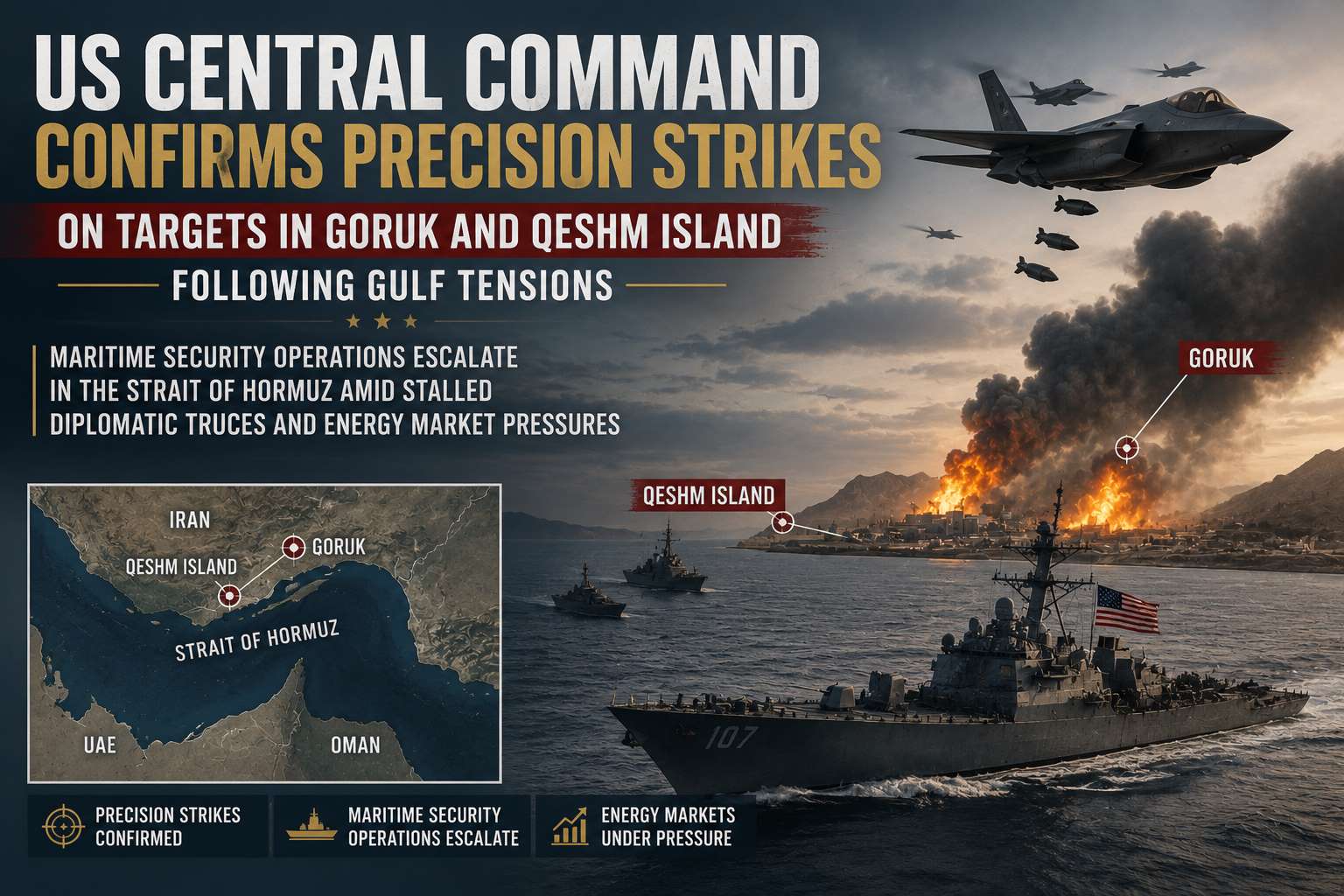
Maritime Security Operations Escalate in the Strait of Hormuz Amid Stalled Diplomatic Truces and Energy Market Pressures
Publication Date: June 1, 2026
Last Updated: June 1, 2026
Byline: Global War News Editorial
Military tensions in the Persian Gulf reached a critical threshold over the weekend. In an official statement released late Sunday, May 31, 2026, United States Central Command (CENTCOM) confirmed it executed a series of precision airstrikes against military infrastructure located in Goruk and on Qeshm Island. According to the defense statement, the targeted locations were being utilized by regional factions to coordinate hostile actions against international shipping vessels operating within the Strait of Hormuz.
The aerial operation marks an escalation in Washington’s regional maritime containment strategy. Speaking from Washington on Monday morning, defense officials stated that the precision strikes successfully degraded coastal missile batteries, long-range unmanned aerial vehicle (UAV) launch sites, and radar tracking stations. The Pentagon maintained that the deployment was defensive, aimed at restoring deterrence after multiple commercial transport vessels reported tracking and harassment by fast-attack naval craft earlier in the week.
Local media channels in the region reported that multiple detonations were heard near the coastal perimeters of Goruk and western Qeshm Island throughout Sunday evening. While local administrative authorities acknowledged structural damage to port-adjacent storage facilities, official state networks have not released verified data regarding casualties. The escalation has immediately disrupted regional transit routes, forcing maritime insurance providers to re-evaluate risk premiums for vessels navigating the narrow choke point.
Context and Background
The Strait of Hormuz remains one of the world’s most critical maritime arteries, with approximately one-fifth of the globe’s liquid petroleum consumption transiting through the channel daily. Qeshm Island, strategically positioned in the narrowest sector of the strait, alongside the coastal town of Goruk on the mainland, historically serve as pivotal surveillance and defensive outposts for regional military forces monitoring international naval traffic.
The current friction follows a series of maritime security disruptions that intensified in early March 2026, when international trade bodies logged an increase in electronic interference and satellite navigation spoofing affecting commercial tankers. The United States and its allies have consistently maintained that ensuring unhindered freedom of navigation through the Persian Gulf is an unalterable tenet of international maritime law.
Conversely, regional authorities have frequently viewed the persistent presence of Western carrier strike groups as a direct breach of territorial sovereignty, using localized naval exercises to assert control over the shipping lanes. The weekend’s direct strikes on mainland and island facilities represent a significant tactical shift, moving beyond the interception of airborne threats at sea to the proactive neutralisation of launch infrastructure on land.
Economic and Humanitarian Impact
The immediate economic fallout from the strikes has reverberated through international energy markets. According to data published by the Intercontinental Exchange (ICE) on Monday morning, Brent crude futures surged by 3.4 percent, trading above $88 per barrel as market analysts priced in the heightened probability of prolonged transit delays through the Gulf.
The physical impact on logistics is already visible. Maritime tracking services reported that at least twelve commercial shipping containers and oil tankers altered their trajectories within hours of the CENTCOM announcement, opting to delay entry into the Strait of Hormuz or anchor in safer waters off the coast of Oman. Shipping analysts from global maritime consultancies note that if the security instability persists past the upcoming week, diverted routes around the Cape of Good Hope could add up to ten days to transit times, significantly raising shipping costs and disrupting manufacturing supply chains across Asia and Europe.
Sourcing accurate local data regarding civilian or military casualties from the targeted zones remains heavily constrained due to tight administrative restrictions and communication blockouts surrounding the military facilities. Independent international humanitarian monitors have expressed concern over the safety of fishing communities on Qeshm Island, noting that localized kinetic actions near port corridors risk disrupting small-scale trade and destroying civilian infrastructure. The United Nations maritime safety division has issued an emergency warning advising all civilian vessels to maintain a wide berth from the designated military sectors near Goruk until comprehensive security assessments are finalized.
International Reactions and Stalled Diplomacy
The precision strikes have drawn sharp criticism from regional powers and triggered mixed reactions among Western allies. In an official diplomatic statement issued on Monday, the Egyptian Ministry of Foreign Affairs expressed deep concern over the expanding geographic scope of military operations in the region, warning that direct strikes on coastal installations threaten to plunge the Middle East into an unmanageable cycle of escalation. The Egyptian government called on all parties to exercise maximum restraint and utilize established diplomatic frameworks to resolve maritime security disputes.
In Europe, French Foreign Minister Jean-Noël Barrot emphasized the vital necessity of maintaining open lines of communication. While acknowledging the right to defend international shipping lanes under international law, Minister Barrot cautioned that unilateral kinetic operations carry severe risks of miscalculation.
The escalation coincides with stalled diplomatic talks in Geneva, where international mediators had been attempting to negotiate a comprehensive maritime code of conduct and de-escalate electronic warfare activities in the Gulf. US defense representatives indicated that while diplomatic channels remain open, military actions will continue to be deployed to neutralize verified, active threats to global trade infrastructure.
Analysis: What This Could Mean
Military analysts suggest that CENTCOM’s decision to strike targets in Goruk and on Qeshm Island indicates a transition from reactive defense to proactive degradation of capabilities. By targeting the sensory and launch infrastructure directly, the US military appears to be establishing a temporary operational window to ensure safer passage for incoming commercial fleets.
However, observers note that striking mainland and island positions introduces significant political and strategic complications. The targeted infrastructure is deeply integrated into the defensive network of regional states, and a sustained campaign could solidify asymmetric resistance rather than deter it.
The deployment of low-cost first-person view (FPV) drones and sea-skimming anti-ship missiles by regional factions remains a persistent challenge for conventional naval defense systems. While precision airstrikes can temporarily disable stationary radar and launch sites, the mobility of modern asymmetric systems allows for rapid redistribution. Unless international diplomatic efforts can successfully leverage the economic costs of shipping disruptions into a verifiable maritime security treaty, the Persian Gulf appears poised to remain a highly volatile theater, keeping global energy prices and international logistics vulnerable to sudden security fluctuations through the middle of 2026.
Source Disclosure: This report relies on official military communiqués issued by United States Central Command (CENTCOM), public briefings from the US Department of Defense, and official press releases from the Egyptian Ministry of Foreign Affairs. Financial metrics, energy market valuations, and maritime tracking data are sourced directly from updates published by the Intercontinental Exchange (ICE), global shipping registries, and independent international news wires including Reuters and Agence France-Presse (AFP). Regional contextual developments are compiled using localized media reporting, though specific casualty and damage assertions remain subject to independent verification.
This article is based on publicly available reporting from named international news agencies and attributed official statements. All claims about ongoing events are attributed to their original sources. Analysis sections represent the editorial interpretation of reported facts and do not constitute advocacy for any party to the described conflict. AI tools may be utilized for image generation to assist in explaining complex concepts, as well as for refining grammar, spelling, and other linguistic enhancements. However, all original content is produced, fact-checked, and revised by the editorial team. This publication does not take political positions on active military conflicts.