
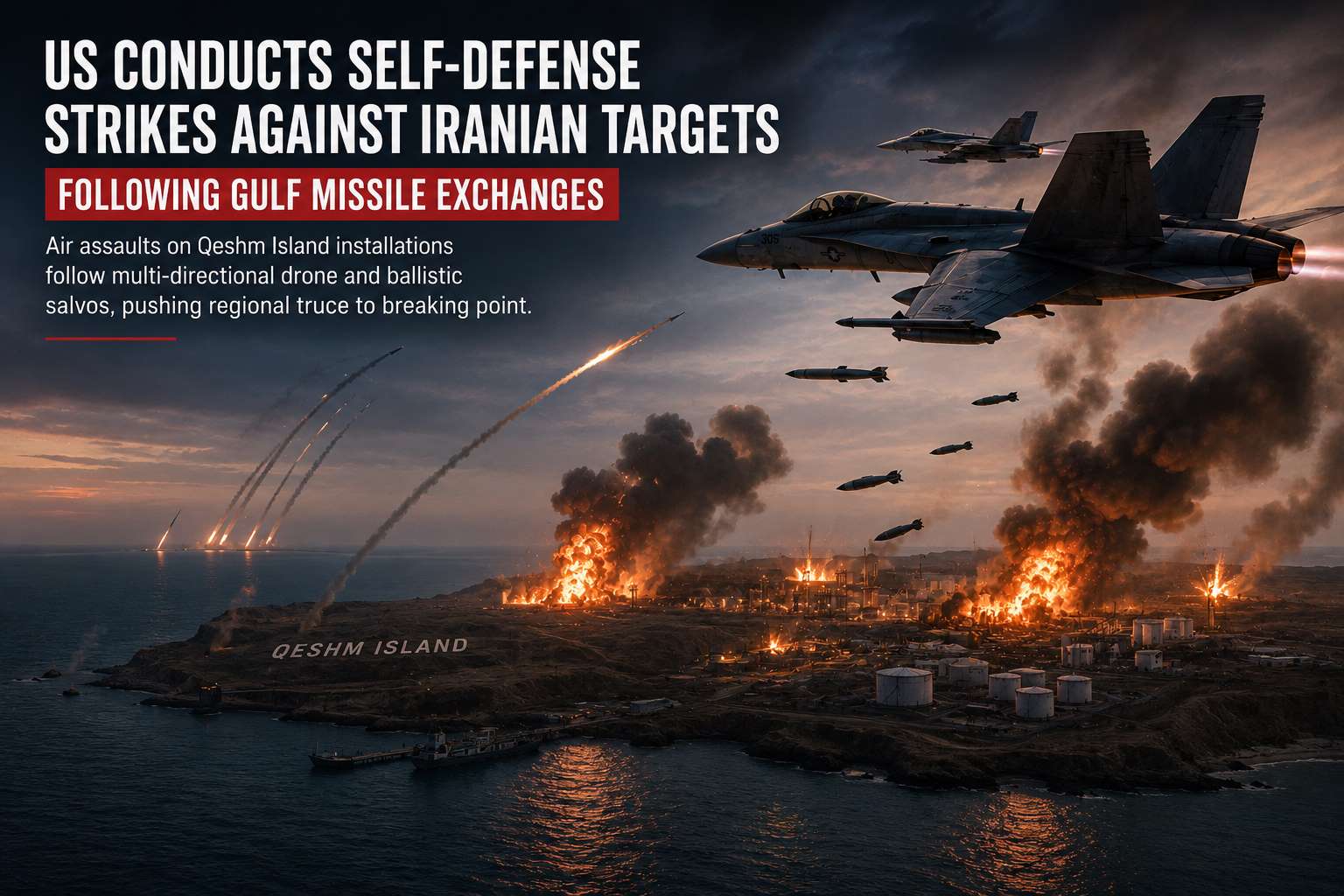
Air assaults on Qeshm Island installations follow multi-directional drone and ballistic salvos, pushing regional truce to breaking point.
Publication Date: June 4, 2026
Last Updated: June 4, 2026
Byline: Global War News Editorial
WASHINGTON; United States military forces launched a series of precision airstrikes against Iranian operational infrastructure in the southern Gulf on Tuesday, following a multi-directional barrage of ballistic missiles and uncrewed aerial vehicles targeted at regional shipping corridors and allied states. The direct military exchange marks the most severe disruption to the United States-enforced naval blockade and the region’s broader temporary truce since negotiations stalled earlier this week.
According to a public directive issued by US Central Command (CENTCOM), American combat aircraft targeted and neutralized an active military ground control station and an associated communications tower operated by the Islamic Revolutionary Guard Corps (IRGC) on Qeshm Island, situated near the strategic Strait of Hormuz. CENTCOM designated the operation as a measured act of self-defense, directly tied to preceding hostile launches originating from mainland Iran.
The Iranian Ministry of Foreign Affairs condemned the aerial incursions, characterizing the strikes on Qeshm Island as a blatant violation of sovereign territory. Concurrently, IRGC command channels released statements asserting that their defensive units responded to the Western operations by deploying targeted salvos against regional staging facilities hosting United States personnel and naval assets.
Tactical Genesis and Escalation Sequence
The direct military friction developed rapidly within a 24-hour window, catalyzed by enforcement mechanisms linked to the active maritime blockade. According to military logs verified by international wire services, the sequence of events progressed through distinct tactical stages:
- Blockade Enforcement Operations: On Tuesday night, a US military aircraft deployed an AGM-114 Hellfire missile targeting the engine room of the Botswana-flagged commercial oil tanker, the M/T Lexie, inside international waters. CENTCOM officials stated the vessel was attempting to bypass the naval blockade to reach Iran’s Kharg Island terminal, having ignored explicit instructions and warnings to change course over a 24-hour period.
- Maritime Drone Deployment: Following the disabling of the tanker, the IRGC launched three one-way attack drones toward commercial shipping vessels transiting international lanes in the Persian Gulf. Naval air defence systems operating under central command parameters intercepted and destroyed all three incoming uncrewed platforms before they could impact civilian maritime assets.
- Airstrikes on Qeshm Island: In immediate retaliation for the drone launches, US fighter aircraft carried out targeted bombardments against the ground command centers on Qeshm Island, which American intelligence identified as the source of the maritime drone operations.
- Ballistic Missiles Launched at Gulf States: Moments after the Qeshm Island installations were hit, Iranian forces initiated ballistic missile launches targeting regional neighbors hosting Western military infrastructure. CENTCOM reported that two ballistic missiles fired toward Kuwait fell short or disintegrated mid-flight, while three separate missiles directed at Bahrain were intercepted by combined US and Bahraini air defense batteries over Manama, preventing impacts on the US Fifth Fleet Headquarters.
Divergent Accounts and Geopolitical Claims
Official statements regarding the operational outcomes differ significantly between the primary combatants. The IRGC announced through its official media portal, Sepah News, that its naval units successfully executed missile strikes against a merchant vessel, the Liberia-flagged MSC Panaya, which it claimed was operating on behalf of Western interests. The Iranian state apparatus further maintained that its ballistic salvos achieved direct impacts on a military airfield in Kuwait where Western helicopters are actively stationed, identifying the installation as the Ali Al Salem Air Base.
United States defense officials swiftly denied these assessments, stating that no American personnel sustained injuries during the multi-directional engagement and confirming that all regional ballistic threats were either intercepted or failed to reach inhabited perimeters.
The escalation has also complicated ongoing parallel negotiations over regional security boundaries. On Monday, US Secretary of State Marco Rubio held consultations with international leaders to propose a phased de-escalation plan, which would require regional groups to halt operations in exchange for a cessation of Western strikes over designated urban centers. However, the suspension of direct US-Iran talks on June 1 by the inner circle of the Iranian regime has significantly narrowed the diplomatic path toward stabilizing these frontlines.
Analysis: Blockade Logistics and Maritime Insurance Volatility
The heavy exchange highlights the systemic difficulties of maintaining a localized naval blockade without triggering wider regional retaliation. Since the implementation of the strict maritime blockade on April 13, US forces have disabled six vessels and turned around 122 ships attempting to access Iranian energy terminals. While previous enforcement actions rarely prompted large-scale responses, Tuesday’s actions indicate that Tehran is increasingly willing to absorb structural damage on its perimeter islands to impose visible tactical risks on neighbouring states that host Western bases.
From an economic perspective, the recurrence of over-the-horizon strikes in the vicinity of the Strait of Hormuz exerts immediate pressure on international markets. Following the breakdown of diplomatic consensus on Monday, Brent crude prices experienced a prompt upward shift, gaining approximately 1.9 per cent to trade at 92.89 US dollars a barrel. Shipping analysts note that if low-altitude drone operations and ballistic threats against civilian logistics hubs continue to bypass established air shields, commercial hull insurance premiums for vessels operating within the northern Gulf could see substantial adjustments, altering transit costs across major international energy routes.
What to Watch
In the immediate term, international observers are focusing on whether the IRGC will deploy secondary anti-ship cruise missile units along its southern coast to contest the ongoing blockade of its ports. Attention is also directed toward whether the governments of Kuwait and Bahrain will implement domestic security restrictions or alter their diplomatic representation in Tehran following the targeting of their sovereign territory. Finally, market monitors will track whether upcoming diplomatic updates from the US State Department can revive stalled talks before regional energy infrastructure suffers compounding physical damage.
Source Disclosure Note: This report incorporates verified information from official public releases provided by US Central Command (CENTCOM), the Kuwaiti Directorate General of Civil Aviation, and the Iranian Ministry of Foreign Affairs. Tactical details and military developments were compiled using field dispatches from Reuters, the Associated Press (AP), and Agence France-Presse (AFP), alongside secondary conflict tracking data published by the Institute for the Study of War (ISW).
This article is based on publicly available reporting from named international news agencies and attributed official statements. All claims about ongoing events are attributed to their original sources. Analysis sections represent the editorial interpretation of reported facts and do not constitute advocacy for any party to the described conflict. AI tools may be utilized for image generation to assist in explaining complex concepts, as well as for refining grammar, spelling, and other linguistic enhancements. However, all original content is produced, fact-checked, and revised by the editorial team. This publication does not take political positions on active military conflicts.