
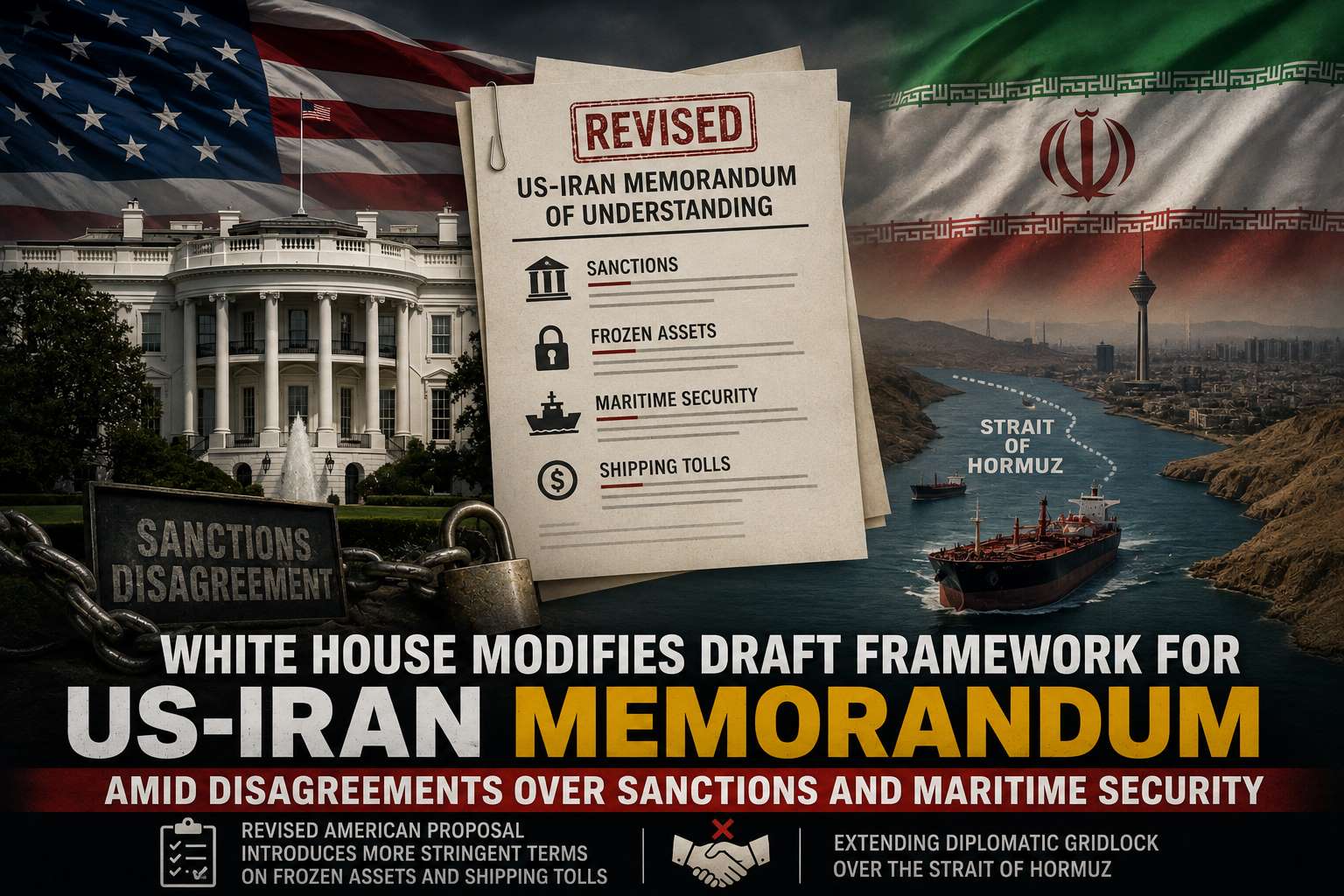
Revised American proposal introduces more stringent terms on frozen assets and shipping tolls, extending diplomatic gridlock over the Strait of Hormuz.
Publication Date: June 1, 2026
Byline: Global War News Editorial
WASHINGTON: The White House has introduced significant modifications to a proposed draft framework for a 60-day Memorandum of Understanding (MOU) with Iran, delaying what international observers anticipated might be a major breakthrough in ending the three-month-old conflict in the Persian Gulf.
According to reports from United States media and statements from senior administrative officials, President Donald Trump returned an amended text to Tehran through intermediaries after raising objections to several core provisions. The revisions primarily target the mechanisms for unfreezing Iranian financial assets and the rules governing international passage through the Strait of Hormuz.
The developments underscore the persistent friction between Washington’s “Economic Fury” campaign and Tehran’s demands for economic guarantees before committing to formal restrictions on its nuclear program.
Redesigning the Draft: The Critical Stumbling Blocks
The framework, which initially emerged after weeks of quiet diplomacy facilitated in part by Pakistani intermediaries, was designed to extend a fragile ceasefire established in April. The proposed 60-day window aimed to provide a stable diplomatic environment for negotiations regarding Iran’s highly enriched uranium stockpile and broader economic sanctions.
However, during a cabinet meeting and subsequent staff briefings, President Trump declined to sign the tentative text. According to internal sources cited by the New York Times, the American administration is seeking much stricter conditions on financial relief, expressing deep reluctance to release billions of dollars in frozen Iranian funds without immediate, verifiable concessions on nuclear enrichment.
Simultaneously, the US Treasury Department’s Office of Foreign Assets Control (OFAC) enacted a counter-terrorism designation against the Persian Gulf Strait Authority (PGSA), an agency established by Tehran on May 5 to assert legal control and collect transit fees over the strategic waterway. The designation effectively warns global shipowners that paying tolls to the PGSA could trigger severe secondary American sanctions.
The Maritime Standoff and Economic Stake
The core of the dispute remains the operational control of the Strait of Hormuz, a maritime chokepoint responsible for approximately one-fifth of the world’s petroleum consumption. Since the outbreak of hostilities on February 28, the passage has been subject to what maritime security analysts have described as a “dual blockade.” Iran has heavily restricted commercial shipping and laid sea mines, while the US Navy has enforced a strict blockade on Iranian ports.
While both sides have agreed in principle to reopen the waterway, the logistical details remain fiercely contested. The US maintains that the strait consists of international waters that must remain entirely free of transit fees. Conversely, Iranian state television indicated that Tehran expects to maintain joint management of traffic alongside Oman, retaining the right to levy transit fees of up to $2 million per vessel to protect its maritime jurisdiction.
In response to these claims, President Trump publicly rejected any shared oversight mechanism, stating that the waterway would remain completely open to international shipping under global monitoring.
Context and Background: Three Months of Regional Escalation
The ongoing crisis was triggered on February 28, 2026, when the United States and Israel initiated coordinated airstrikes under Operation Epic Fury, targeting Iranian command structures and military infrastructure. The operation resulted in the death of Iran’s long-serving Supreme Leader, Ali Khamenei.
In retaliation, the Islamic Revolutionary Guard Corps (IRGC) targeted regional US bases and shipping assets, grinding commercial traffic in the Persian Gulf to a near-total halt. The subsequent collapse in shipping volumes triggered an immediate global fuel crisis, prompting Washington to launch Operation Project Freedom in early May to escort merchant vessels through the region.
Diplomatic relations have been further complicated by recent leadership transitions in Tehran, where the proposal has reportedly been submitted to the new Supreme Leader, Mojtaba Khamenei, for review. The Iranian Parliament Speaker, Mohammad Bagher Ghalibaf, stated publicly that Tehran would not approve any text until the economic rights of the country are fully protected, indicating a mirrored reluctance to accept the revised Washington draft.
Analysis: What the Gridlock Means for Global Markets
Market analysts suggest that the current impasse will likely sustain elevated energy prices and insurance premiums for merchant shipping in the medium term. The initial reports of a potential MOU had briefly eased anxieties in international markets, as the agreement promised a temporary suspension of some US sanctions, potentially allowing Iran to resume unrestricted oil exports for the first time in nearly eight years.
The introduction of tougher terms by the White House highlights a calculated negotiating strategy. By keeping the naval blockade intact and adding fresh designations against Iranian maritime agencies, Washington appears to be attempting to maximize economic leverage before the 60-day clock begins.
However, observers note that this approach carries high risks. If communication channels through Pakistani intermediaries stall due to the tougher terms, the risk of technical violations of the current ceasefire increases, potentially plunging the Persian Gulf back into active kinetic conflict.
What to Watch
Moving forward, the primary indicator of diplomatic progress will be Tehran’s formal response to the revised American text. Journalists and regional observers are closely monitoring whether Pakistani mediators can bridge the gap regarding transit fees and asset releases. Furthermore, the actions of commercial fleets will be critical; shipowners must navigate the legal minefield of avoiding PGSA transit fees while ensuring the physical safety of their crews in highly volatile waters.
Source Disclosure Note: This report relies on official statements from US Vice President JD Vance and Treasury Secretary Scott Bessent, public remarks by Iranian Parliament Speaker Mohammad Bagher Ghalibaf, maritime data compiled by Vanguard Tech, and independent reporting from Reuters, the New York Times, Axios, and Seatrade Maritime News.
This article is based on publicly available reporting from named international news agencies and attributed official statements. All claims about ongoing events are attributed to their original sources. Analysis sections represent the editorial interpretation of reported facts and do not constitute advocacy for any party to the described conflict. AI tools may be utilized for image generation to assist in explaining complex concepts, as well as for refining grammar, spelling, and other linguistic enhancements. However, all original content is produced, fact-checked, and revised by the editorial team. This publication does not take political positions on active military conflicts.