
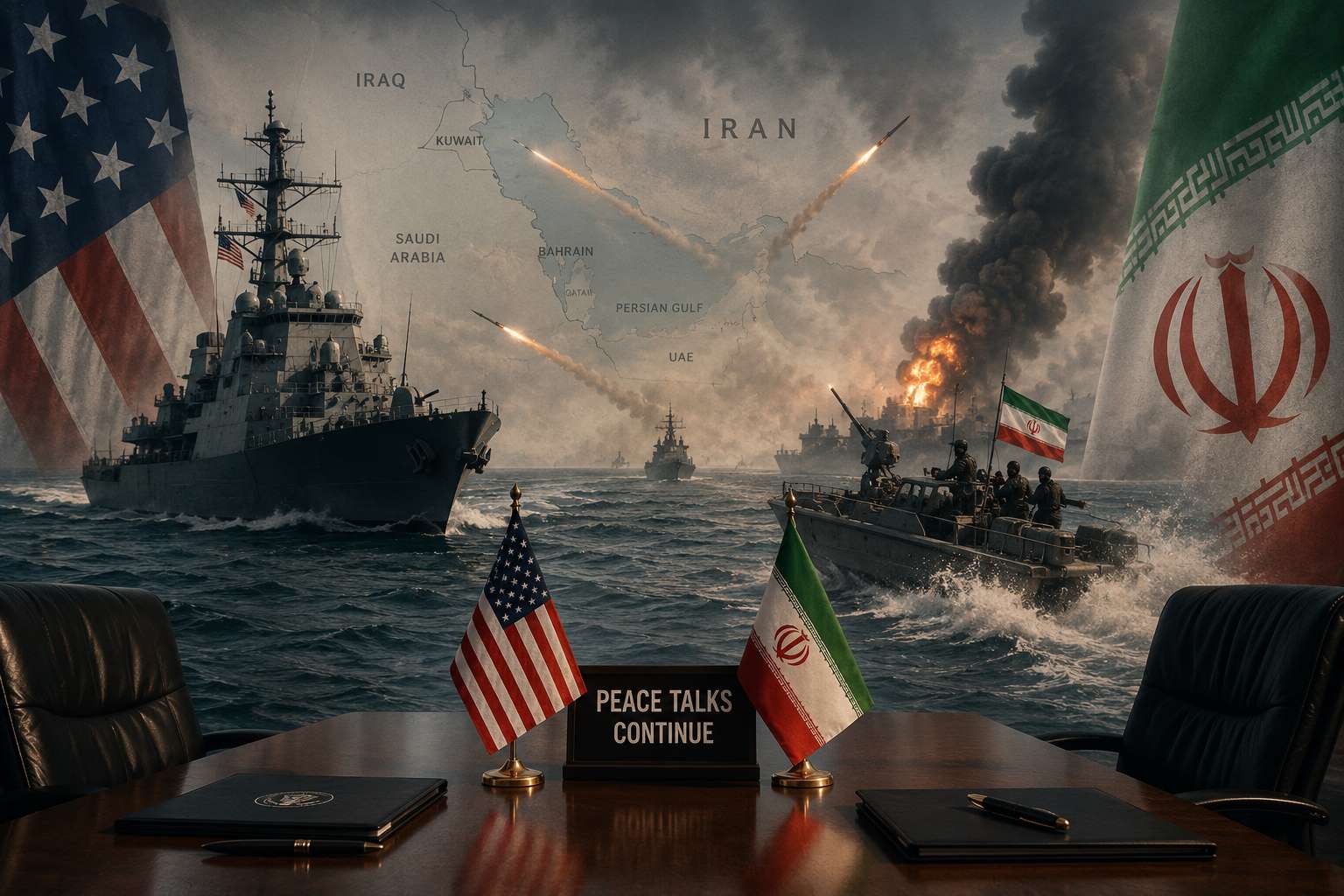
Direct diplomatic channels face severe operational stress in Washington as enforcement of the maritime blockade triggers reciprocal retaliatory cycles.
Publication Date: June 4, 2026
Last Updated: June 4, 2026
Byline: Global War News Editorial
WASHINGTON; Direct diplomatic negotiations between the United States and Iran aimed at establishing a comprehensive regional truce are continuing under severe operational strain following a series of high-intensity military exchanges in the Persian Gulf. The survival of the bilateral diplomatic channel faces its most critical challenge since a temporary ceasefire framework showed signs of fragmentation earlier this week.
According to statements from officials within the US State Department, diplomatic teams have maintained communication despite the recent outbreak of hostilities. US Secretary of State Marco Rubio held consultations with international mediators on Monday to propose a structured, phased de-escalation plan. The proposal requires regional aligned groups to halt forward operations in exchange for a verified cessation of Western air strikes over designated urban centers.
The Iranian Ministry of Foreign Affairs confirmed that diplomatic notes continue to be exchanged through backchannels, but cautioned that ongoing Western military operations directly undermine the foundational trust required for a binding agreement. Spokespersons for the Islamic Revolutionary Guard Corps (IRGC) stated that while diplomatic tracks exist, Iranian forces will maintain a posture of active deterrence as long as United States naval assets enforce trade restrictions in international waters.
Chronology of the Tactical Flare-Up
The severe friction threatening the Washington talks developed rapidly within a 24-hour window, catalyzed by the rigid enforcement of an active maritime blockade. According to military logs released by US Central Command (CENTCOM) and regional state media, the sequence of military actions progressed through distinct stages:
- The Tanker Interdiction: On Tuesday night, a US military aircraft deployed an AGM-114 Hellfire missile to disable the engine room of the Botswana-flagged commercial oil tanker, the M/T Lexie, inside international waters. CENTCOM officials stated the vessel was attempting to bypass the naval blockade to reach Iran’s Kharg Island terminal, having ignored explicit instructions and warnings to alter its course over a 24-hour period.
- The Drone Retaliation: Following the disabling of the tanker, the IRGC deployed three one-way attack drones toward commercial shipping vessels transiting international lanes in the Persian Gulf. Naval air defence systems operating under CENTCOM parameters intercepted and neutralized all three incoming uncrewed platforms.
- The Qeshm Island Strikes: In response to the drone launches, US fighter aircraft carried out precision strikes against an IRGC ground command center and an associated communications tower on Qeshm Island, which American intelligence identified as the launch origin point for the maritime drone operations.
- The Ballistic Salvos: Moments after the Qeshm Island installations were hit, Iranian forces initiated ballistic missile launches targeting regional neighbors hosting Western military infrastructure. CENTCOM reported that two ballistic missiles directed toward Kuwait fell short or disintegrated mid-flight, while three separate missiles directed at Bahrain were intercepted by combined US and Bahraini air defense batteries over Manama, preventing impacts on the US Fifth Fleet Headquarters.
Discrepancies in Official Claims
Official accounts regarding the structural outcomes and targets of Tuesday’s exchange differ sharply between the primary combatants. The IRGC announced through its official media portal, Sepah News, that its naval units successfully executed missile strikes against a merchant vessel, the Liberia-flagged MSC Panaya, which it claimed was operating on behalf of Western interests.
Furthermore, the Iranian state apparatus maintained that its ballistic salvos achieved direct impacts on a military airfield hosting US helicopters in Kuwait, identifying the installation as the Ali Al Salem Air Base. Iranian state media alleged that a US-operated Patriot interceptor missile failed and struck Terminal 1 of Kuwait International Airport, causing the severe structural damage and single civilian fatality reported there.
United States defense officials swiftly denied the Iranian assessments, stating that no American personnel sustained injuries during the multi-directional engagement and confirming that all regional ballistic threats aimed at military bases were successfully suppressed. Kuwaiti authorities, meanwhile, attributed the airport terminal damage entirely to Iranian drone impacts, formalizing their protest by declaring two Iranian diplomats persona non grata and ordering a reduction in Tehran’s local embassy staff.
Analysis: Interceptor Stockpiles and Blockade Friction
The core paradox complicating the Washington peace talks lies in the operational mechanics of the maritime blockade. Since the implementation of strict trade restrictions on April 13, US forces have disabled six vessels and turned around 122 ships attempting to access Iranian energy terminals. While these actions are designed to exert economic pressure and force diplomatic concessions, each physical interdiction runs the risk of provoking an asymmetric military response from Tehran.
Military observers note that this circular pattern of strike and counter-strike places a critical strain on global air defense logistics. Months of multi-directional drone and missile engagements across the Middle East have heavily extended Western defense production lines, running down stockpiles of high-altitude interceptors like the Patriot and Arrow networks. Analysts suggest that Tehran’s tactical willingness to target civilian transit hubs and logistics networks in neighboring states is specifically calibrated to exploit these interceptor shortages, raising the cost of blockade enforcement for Washington and its regional allies.
The diplomatic landscape is further obscured by shifting political structures within Iran. On June 1, the inner circle of the Iranian regime temporarily suspended direct message exchanges with Western mediators, narrowing the diplomatic path toward stabilizing the frontlines. Although backchannels have since reopened to preserve the talks, the lack of a unified political consensus in Tehran means that local commanders on the ground retain significant latitude, increasing the risk that a tactical miscalculation could completely collapse the negotiation framework.
What to Watch
In the coming days, international monitors are focusing on whether the US State Department will offer a conditional easing of the naval blockade on non-oil commercial shipping to keep the Iranian diplomatic delegation at the table. Attention is also directed toward whether Bahrain and Kuwait will demand a redistribution of Western air defense assets to better protect their civilian infrastructure from secondary strike fragments. Finally, commodity markets will track whether the ongoing direct talks in Washington can establish an immediate, verified pause in maritime interdictions, as any further escalation near the Strait of Hormuz could push Brent crude futures past current volatile thresholds.
Source Disclosure Note: This report is compiled from verified public statements and briefings issued by the US State Department, US Central Command (CENTOM), the Iranian Ministry of Foreign Affairs, and the Kuwaiti Directorate General of Civil Aviation. Tactical developments and regional diplomatic tracking were sourced from field dispatches provided by Reuters, the Associated Press (AP), and Agence France-Presse (AFP).
This article is based on publicly available reporting from named international news agencies and attributed official statements. All claims about ongoing events are attributed to their original sources. Analysis sections represent the editorial interpretation of reported facts and do not constitute advocacy for any party to the described conflict. AI tools may be utilized for image generation to assist in explaining complex concepts, as well as for refining grammar, spelling, and other linguistic enhancements. However, all original content is produced, fact-checked, and revised by the editorial team. This publication does not take political positions on active military conflicts.