
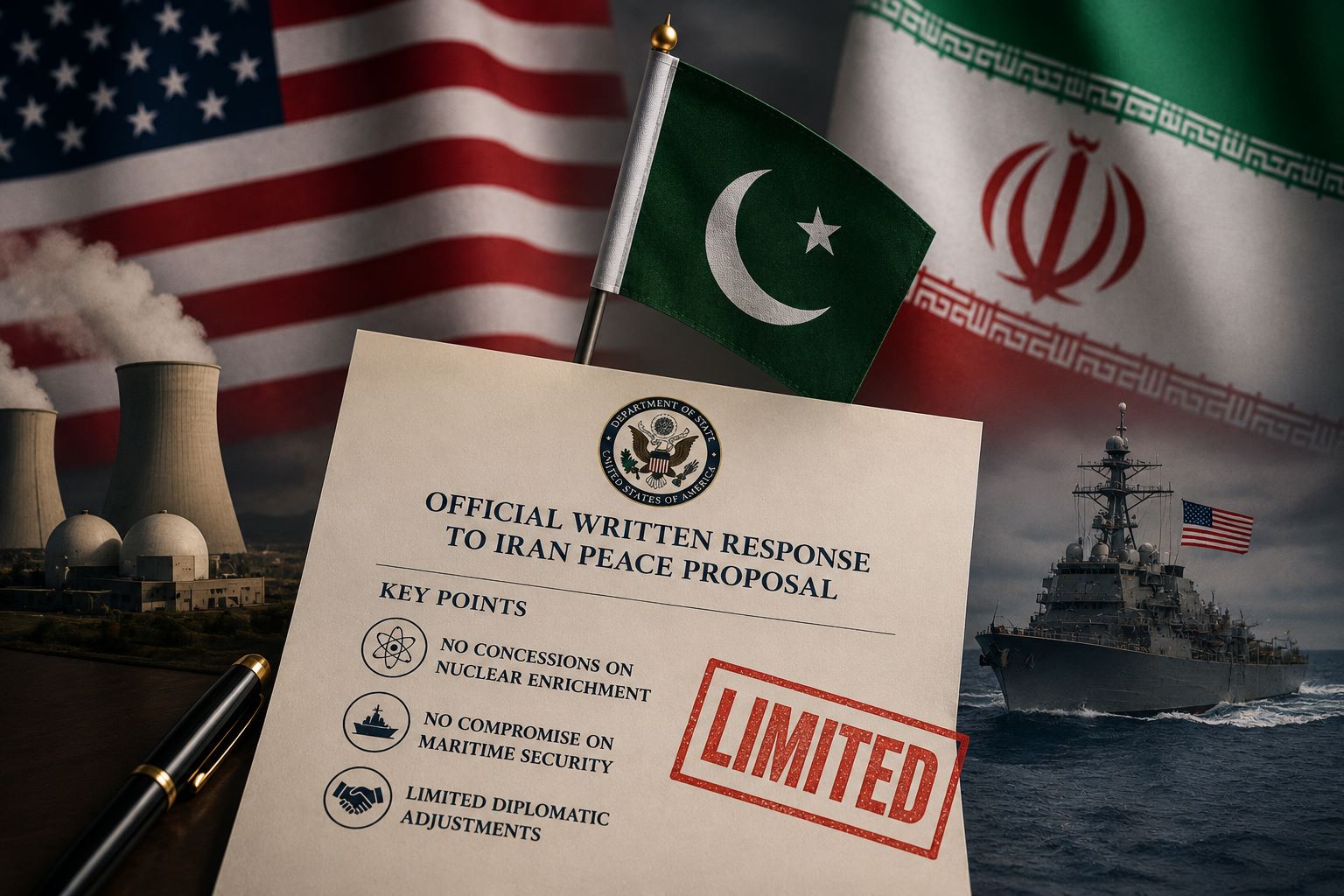
Washington maintains rigid core demands on nuclear enrichment and maritime security while offering minor diplomatic adjustments through Pakistani intermediaries.
Publication Date: May 18, 2026
Last Updated: May 18, 2026
Byline: Global War News Editorial
The United States government has delivered its formal, written response to Iran’s recent comprehensive peace proposal, explicitly limiting the scope of potential American concessions. The document, transmitted via Pakistani diplomatic channels in Islamabad, outlines the definitive boundary of the Trump administration’s willingness to negotiate over regional security architecture and economic sanctions.
According to a press briefing by US Vice President JD Vance, the written text reinforces Washington’s core security demands while rejecting the structural sequencing proposed by Tehran. The diplomatic exchange comes during an unstable, multi-week ceasefire that paused intensive joint aerial operations conducted by Western forces against Iranian infrastructure targets earlier this year.
While the delivery of an official written response confirms that communication channels remain open, the rigid parameters established by the United States indicate a widening gap between the two sides. International observers suggest that the current American posture aims to test the resilience of the Iranian economy under a strict naval blockade, using the threat of resumed infrastructure strikes as primary leverage.
Core Redlines and Rejected Frameworks
The official US document addresses the 14-point counterproposal submitted by Iranian Foreign Minister Abbas Araghchi in April. According to reports from the Associated Press citing senior State Department officials, the United States explicitly rejected Iran’s demand for the immediate, synchronized lifting of primary economic and energy sanctions as a pre-condition for subsequent talks.
The Trump administration’s response maintains that sanctions relief will only follow the verifiable execution of specific nuclear and military rollbacks. Chief among these is the demand that Iran permanently cap its uranium enrichment operations at civilian-grade levels and transfer its existing stockpile of highly enriched material to a third-party country under international oversight.
Furthermore, the written text addresses the controversial transit fee mechanism proposed by Tehran for commercial vessels navigating the Strait of Hormuz. The United States stated that it will not recognize any regulatory shipping toll or inspection regime managed by Iran in international waters, classifying such measures as unlawful disruptions to global maritime commerce.
Technical Coordination and the Mediation Track
The transmission of the document was managed directly by the Pakistani Ministry of Foreign Affairs, which continues to serve as the principal intermediary between the non-communicating capitals. Pakistani Prime Minister Shehbaz Sharif confirmed that the text was handed over to Iranian representatives in Islamabad on Sunday evening.
Diplomatic dispatches indicate that while the United States remained unyielding on its core strategic objectives, it offered minor technical adjustments regarding the logistics of future talks. These include a willingness to establish direct, bilateral working groups on civilian aviation safety and the unfreezing of limited, specific humanitarian assets strictly designated for food and medical imports, provided that verification protocols are managed by the World Bank.
In Tehran, state media outlets, including the IRNA news agency, acknowledged receipt of the American text. Initial commentaries from members of the Iranian parliament’s National Security Committee characterized the US response as a continuation of a maximum pressure strategy, arguing that the document fails to provide the binding legal guarantees required to sustain a long-term treaty.
Context and Background: The Islamabad Process
The current diplomatic impasse follows the outbreak of open hostilities on February 28, 2026, which led to significant damage across Iranian military supply networks. A temporary truce brokered by Pakistan on April 8 successfully halted large-scale bombardment, but successive rounds of indirect talks have struggled to transition the ceasefire into a permanent peace framework.
The Trump administration’s foreign policy approach relies on extracting structural concessions through intense economic isolation. A multinational naval task force continues to enforce an active blockade on Iranian crude oil exports in the Persian Gulf, a measure that has severely restricted Tehran’s foreign exchange reserves and forced domestic industries to operate under emergency energy rationing.
Iran’s counter-strategy has centered on utilizing its regional influence and maritime positioning to increase the economic cost of the blockade for Western allies. The threat to implement a commercial transit toll in the Strait of Hormuz was designed to pressure international energy markets, creating a secondary front in the negotiation process that Washington is now attempting to neutralize through its latest written directive.
Analysis: The Strategy of Absolute Leverage
Observers note that by limiting the scope of its concessions, the Trump administration is wagering that Iran’s internal economic pressures will eventually compel its leadership to accept a asymmetrical agreement. The inclusion of minor humanitarian asset provisions represents a tactical opening, offering Tehran a path to alleviate domestic civilian strain without requiring Washington to dismantle its primary sanctions architecture.
However, this rigid framework carries distinct operational risks. By leaving little room for diplomatic compromise on the core issue of domestic uranium enrichment, the US response may inadvertently empower conservative factions within the Iranian political establishment who argue that negotiations with Washington are fundamentally unviable.
If Tehran determines that the written response offers no realistic path toward meaningful sanctions relief, the incentive to maintain the fragile April ceasefire will diminish significantly. Under these conditions, the likelihood of a tactical miscalculation in the Persian Gulf increases, as either side may choose to resume localized kinetic operations to alter the balance of leverage before the summer concludes.
What to Watch
The immediate indicator of how this response will shape the conflict will be the formal statement expected from Iranian Foreign Minister Abbas Araghchi following his consultations with the Supreme National Security Council in Tehran.
Additionally, tracking data in the Strait of Hormuz will reveal whether Iran attempts to accelerate the enforcement of its proposed shipping tolls as a direct geopolitical answer to the rejection of its peace terms.
Source Disclosure Note: This report is based on public briefings delivered by US Vice President JD Vance and official background statements from the US State Department. Iranian reactions are sourced from the state-affiliated IRNA news agency and public comments by parliamentary committee members. Logistical details regarding the transmission of the documents are drawn from official press releases issued by the Pakistani Ministry of Foreign Affairs and independent reporting by Reuters and the Associated Press.
This article is based on publicly available reporting from named international news agencies and attributed official statements. All claims about ongoing events are attributed to their original sources. Analysis sections represent the editorial interpretation of reported facts and do not constitute advocacy for any party to the described conflict. AI tools may be utilized for image generation to assist in explaining complex concepts, as well as for refining grammar, spelling, and other linguistic enhancements. However, all original content is produced, fact-checked, and revised by the editorial team. This publication does not take political positions on active military conflicts.