
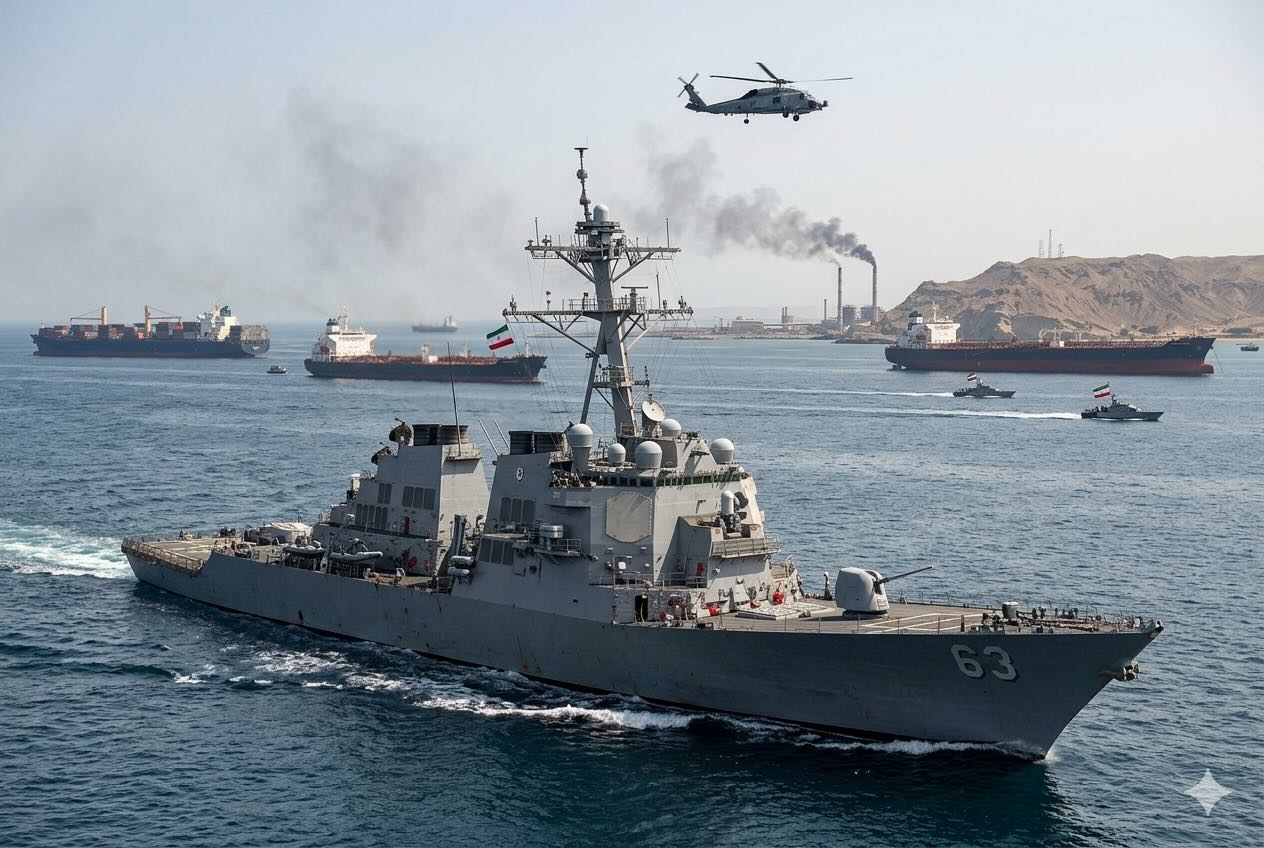
President Trump orders naval interdiction after Islamabad peace talks collapse; Iran warns “no port in the region will be safe.”
Published: April 14, 2026
Last Updated: 17:15 GMT
By Global War News Editorial
The United States Navy officially commenced a high-stakes blockade of all Iranian maritime gateways yesterday, marking a severe escalation in the month-long conflict. U.S. Central Command (CENTCOM) confirmed that as of 14:00 GMT on April 13, 2026, naval forces began interdicting all vessels entering or departing Iranian ports and coastal areas across the Arabian Gulf and the Gulf of Oman.
The move followed a breakdown in marathon negotiations held over the weekend in Islamabad, Pakistan. U.S. President Donald Trump, speaking via social media and official statements, asserted that while the talks were “largely productive,” the Iranian delegation refused to provide sufficient guarantees regarding its nuclear program. “Iran is unwilling to give up its nuclear ambitions,” the President stated, adding that the blockade would remain in place until “free navigation is restored” without Iranian interference or “illegal tolls.”
Tehran’s Response: “Act of Piracy”
Tehran has reacted with a blend of diplomatic condemnation and military threats. An Iranian Armed Forces spokesperson characterized the U.S. maneuver as “illegal” and “amounting to piracy,” noting that it violates international maritime law regarding the right of innocent passage.
Iranian state media IRIB quoted military officials warning that the security of the Persian Gulf is “indivisible.” A spokesperson stated, “Security is either for everyone or for no one. No port in the region will be safe” if Iranian trade remains strangled. This has heightened fears among neighboring Gulf states, particularly the UAE and Saudi Arabia, which rely on the same waters for their energy exports.
The Duel of Blockades
The situation in the Strait of Hormuz has devolved into what maritime analysts are calling a “double blockade”:
- The U.S. Position: CENTCOM clarified that it is not blocking the Strait of Hormuz for vessels traveling to and from non-Iranian ports (such as those in Kuwait or Iraq). However, it will interdict any vessel in international waters that has acceded to Iran’s unilaterally imposed “protection racket” or paid transit tolls to Tehran.
- The Iranian Position: Iran continues to claim “full control” of the Strait, utilizing a traffic separation scheme that forces ships into its territorial waters. Reports from the Institute for the Study of War (ISW) indicate that Iran is using threats and sea mines to maintain a “hazardous area” across the chokepoint.
Analysis: Economic Aftermath and Global Shipping
The immediate economic impact has been felt in global energy markets, with oil prices climbing over $100 per barrel following the announcement. Shipping data from Kpler and MarineTraffic showed that despite the blockade, at least one Chinese-owned tanker, the Rich Starry, successfully transited the Strait on Tuesday, signaling potential defiance from sanctioned entities.
Economists note that the blockade’s success depends on whether the U.S. can sustain the pressure without alienating allies. While the U.S. has invited international participation, officials from the UK and Spain have already stated they will not participate in the blockade itself, though France and the UK are reportedly discussing a separate “defensive mission” to secure general navigation.
What to Watch
The primary focus now shifts to whether the “fragile” 14-day ceasefire—originally intended for the Islamabad talks—will collapse into direct kinetic engagement. Iranian military advisors have suggested they have “untouched levers” to counter the blockade, which observers interpret as a reference to ballistic missile strikes or swarm boat attacks against the U.S. fleet.
Sources: Reuters, Associated Press (AP), Gulf News, Institute for the Study of War (ISW), LSEG Shipping Data, Times of Israel, IRIB State Media.
This article is based on publicly available reporting from named international news agencies and attributed official statements. All claims about ongoing events are attributed to their original sources. Analysis sections represent the editorial interpretation of reported facts and do not constitute advocacy for any party to the described conflict. AI tools may be utilized for image generation to assist in explaining complex concepts, as well as for refining grammar, spelling, and other linguistic enhancements. However, all original content is produced, fact-checked, and revised by the editorial team. This publication does not take political positions on active military conflicts.