
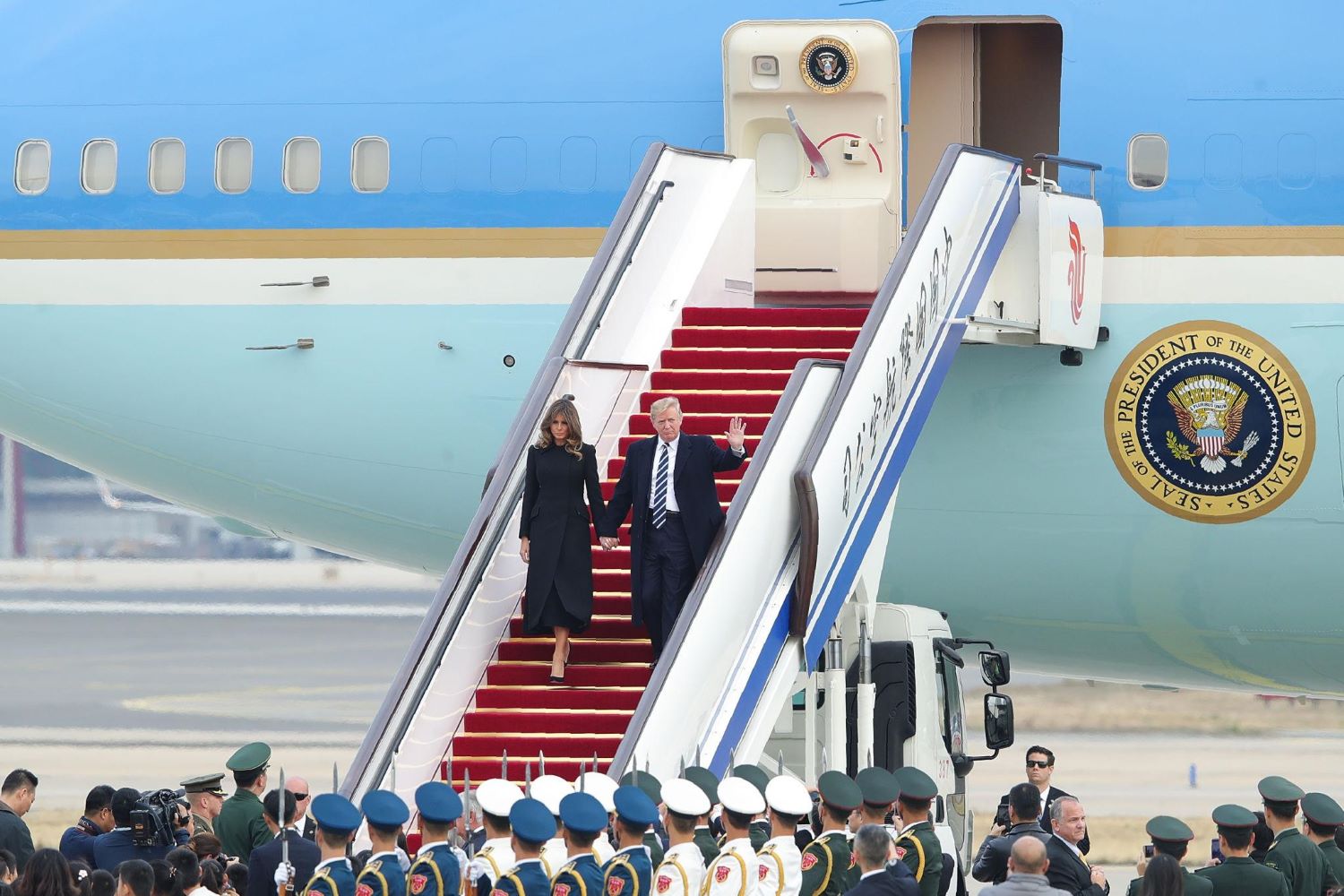
Bilateral discussions in Beijing raise cautious optimism for economic stabilization despite unresolved differences over regional maritime security.
Publication Date: May 18, 2026
Last Updated: May 18, 2026
Byline: Global War News Editorial
US Vice President JD Vance has reported incremental progress in ongoing diplomatic discussions aimed at stabilizing trade relations and mitigating regional security risks. The announcement coincides with the arrival of US President Donald Trump in Beijing for a scheduled series of high-level meetings with Chinese officials. The visit represents the most significant direct engagement between the two economic superpowers this year, following months of heightened economic friction and naval posturing in the Indo-Pacific region.
Speaking to reporters prior to the presidential landing, Vice President Vance indicated that preliminary working groups have established a baseline framework for addressing bilateral trade imbalances and supply chain security. However, Vance emphasized that significant divergence remains on critical geopolitical friction points, particularly regarding maritime transit rights and technology transfer regulations.
The Beijing summit has drawn intense interest from international markets, which have experienced prolonged volatility due to persistent tariff disputes and strategic competition. While official agendas focus heavily on economic stabilization, observers note that the underlying security architecture of the Western Pacific remains the unspoken focal point of the leadership meetings.
Areas of Reported Progress and Framework Negotiations
The diplomatic groundwork leading up to the Beijing summit involved weeks of quiet negotiations handled by secondary ministerial teams. According to a briefing by the US State Department, the two nations have reached a tentative agreement to resume regular, high-level military-to-military communications, a mechanism that had been partially suspended following a series of naval encounters in the South China Sea late last year.
Vice President Vance stated that the preliminary talks also yielded a mutual commitment to review specific export controls on dual-use technologies, which could provide relief to global semiconductor supply chains. The proposed framework aims to establish a joint oversight commission to vet technology transfers, though the exact parameters of this body have not yet been finalized.
Chinese state media, reporting via the Xinhua News Agency, offered a similarly cautious assessment of the pre-summit talks. Statements from the Chinese Ministry of Foreign Affairs acknowledged that while the dialogue has been constructive, any permanent stabilization of ties requires the mutual recognition of core strategic interests. The Chinese delegation, reportedly led by Foreign Minister Wang Yi during the preparatory phases, has maintained that economic restrictions must be lifted before a broader security accord can be reached.
Security Flashpoints and the Maritime Dispute
Despite the positive rhetorical tone surrounding the economic discussions, the strategic rivalry between Washington and Beijing continues to present a significant risk of escalation. The primary point of contention remains the deployment of naval assets along critical global shipping lanes.
According to data compiled by the US Naval Institute, both the United States and its regional allies—including Japan and Australia—have maintained an elevated naval presence in the Philippine Sea. Concurrently, the People’s Liberation Navy has conducted large-scale readiness exercises within the first island chain.
Analysts have suggested that the current diplomatic push is less about achieving an immediate, comprehensive treaty and more about establishing crisis-management protocols to prevent an accidental kinetic clash. In his public remarks, Vice President Vance explicitly noted that while trade discussions are moving forward, the United States will not alter its operational posture regarding freedom of navigation operations in international waters.
Context and Background: The Path to the Beijing Summit
The current diplomatic push follows a period of severe economic decoupling that accelerated throughout 2025. Following the implementation of a series of sweeping reciprocal tariffs on industrial machinery and rare earth minerals, trade volume between the world’s two largest economies dropped to its lowest level in a decade, according to data published by the World Bank earlier this year.
The economic strain has had widespread secondary effects, particularly across manufacturing sectors in Southeast Asia and Europe. The International Monetary Fund noted in its April quarterly report that prolonged trade instability between the US and China remained the single largest risk factor to global GDP growth in 2026.
Previous attempts to mediate the trade dispute through European intermediaries in Geneva failed to produce a workable framework, largely due to disagreements over intellectual property enforcement. The decision to shift to direct, leader-level summitry in Beijing indicates that both administrations view the current economic trajectory as mutually unsustainable.
Analysis: The Limits of Cautious Optimism
Observers note that while the rhetoric from Vice President Vance suggests a diplomatic opening, structural realities will likely limit the scope of any final agreement. The Trump administration’s foreign policy model relies heavily on bilateral leverage, using the threat of expanded tariffs to extract specific economic concessions. While this approach can yield short-term purchase agreements, it rarely addresses the long-term strategic competition that defines the relationship.
Furthermore, any progress made on the economic front remains highly vulnerable to sudden disruption from unrelated security incidents. A single miscalculation by naval commanders in the contested waters of the Pacific could instantly derail the progress reported by Vance.
For the Chinese leadership, the summit presents an opportunity to project diplomatic parity with Washington while seeking relief from economic pressures that have slowed domestic growth. Consequently, the most likely outcome of the high-level meetings is a temporary stabilization framework—a tactical pause rather than a fundamental resolution of the geopolitical rivalry.
What to Watch
The true measure of success for the Beijing summit will lie in the joint communiqués issued at the conclusion of the presidential meetings. Investors and analysts will be watching closely for any specific timelines regarding tariff reductions or concrete steps toward establishing the joint technology oversight commission.
In the immediate term, naval tracking data from the region will serve as a practical indicator of whether the diplomatic progress reported by Vice President Vance translates into a reduction of operational friction on the high seas.
Source Disclosure Note: This report is based on official statements issued by US Vice President JD Vance and the US State Department. Chinese government positions are sourced from official briefings transmitted by the Xinhua News Agency and the Chinese Ministry of Foreign Affairs. Additional economic context and data points are drawn from published reports by the World Bank, the International Monetary Fund, and independent tracking by the US Naval Institute.
This article is based on publicly available reporting from named international news agencies and attributed official statements. All claims about ongoing events are attributed to their original sources. Analysis sections represent the editorial interpretation of reported facts and do not constitute advocacy for any party to the described conflict. AI tools may be utilized for image generation to assist in explaining complex concepts, as well as for refining grammar, spelling, and other linguistic enhancements. However, all original content is produced, fact-checked, and revised by the editorial team. This publication does not take political positions on active military conflicts.