
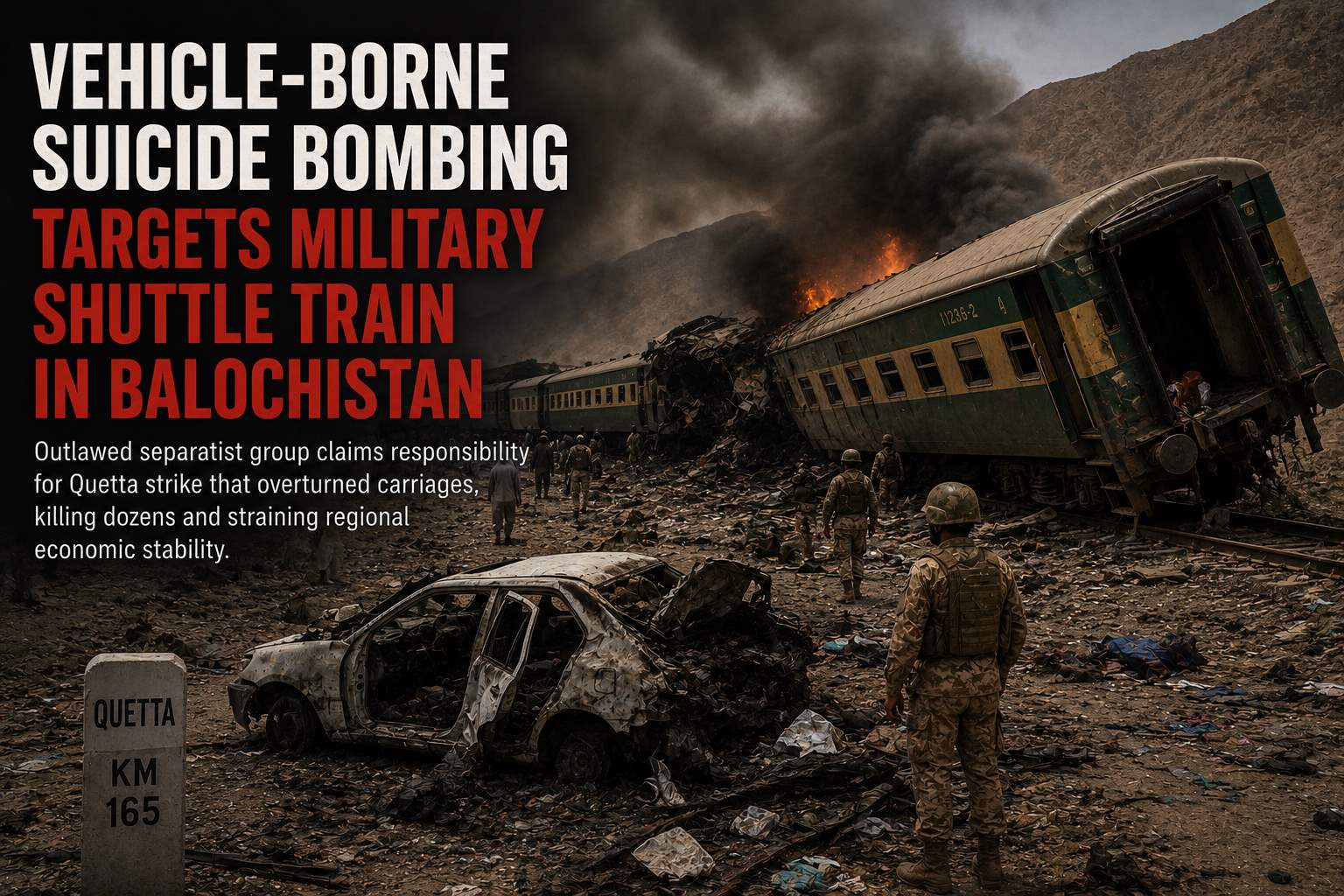
Outlawed separatist group claims responsibility for Quetta strike that overturned carriages, killing dozens and straining regional economic stability.
Publication Date: May 26, 2026
Byline: Global War News Editorial
A devastating vehicle-borne suicide bombing targeted a passenger shuttle train in Quetta, the provincial capital of Pakistan’s southwestern Balochistan province, on Sunday morning. The explosion inflicted massive structural damage on the transit network, derailed several coaches, and caused high-volume casualties, marking a severe escalation in the region’s long-running separatist insurgency.
According to initial statements from local transit authorities and regional emergency services on May 24, 2026, the attack occurred at approximately 8:00 a.m. local time near the Chaman Phatak railway crossing. The outlawed Balochistan Liberation Army (BLA), a separatist militant group designated as a terrorist organization by multiple international jurisdictions, claimed responsibility for the operation shortly after the blast.
The Attack Mechanics and Immediate Casualties
The strike specifically targeted a localized shuttle train that was transporting Pakistani military personnel and their family members from the Quetta Cantonment area toward the main city railway station. The passengers were scheduled to connect with the Jaffar Express, a major national rail link.
According to Pakistan Federal Minister for Railways Hanif Abbasi, an explosives-laden vehicle was driven directly into one of the train’s midsection passenger carriages as it moved through a high-security zone. The kinetic force and thermal energy of the blast instantly derailed the train’s locomotive engine and three adjacent coaches. Two passenger carriages overturned completely and caught fire, sending plumes of dense black smoke over nearby residential blocks.
Local emergency management and hospital officials reported an initial death toll of 24 people, though subsequent field tracking by recovery teams indicated the fatalities had risen significantly as critically wounded individuals succumbed to their injuries. Among the dead are at least 20 army servicemen and paramilitary Frontier Corps personnel, alongside civilian bystanders and residents of nearby housing units. More than 70 people sustained severe trauma injuries, with medical directors at Quetta’s public hospitals warning that at least 20 patients remained in critical condition.
Tactical Context and Group Motivation
The BLA issued a formal statement to media channels confirming that its tactical unit executed the suicide operation specifically to target security forces. The group has waged a low-level guerilla campaign for decades, asserting that Islamabad systematically exploits the vast mineral, natural gas, and oil wealth of Balochistan without delivering economic equity or infrastructure development to local ethnic Baloch communities.
The incident is part of a pattern of coordinated attacks focusing on state infrastructure:
- The 2024 Quetta Station Bombing: A previous suicide strike at a main terminal platform that killed 26 individuals, establishing a precedent for targeting rail networks.
- The 2025 Hijacking: A major security breach involving the temporary seizure of the Jaffar Express.
- Pre-Attack Shootouts: The bombing occurred precisely 24 hours after a severe tactical engagement on the outskirts of Quetta left nine suspected separatists and four counter-terrorism officers dead.
Political Responses and Regional Allegations
The attack drew immediate condemnation from the highest levels of Pakistan’s civilian government. Prime Minister Shehbaz Sharif characterized the bombing as a cowardly act of structural terror and ordered immediate federal assistance for the victims’ families. Balochistan Chief Minister Sarfraz Bugti issued a public directive to regional law enforcement to track down the network’s facilitators, stating that the targeting of transit infrastructure carrying women and children would be met with an unyielding military response.
Furthermore, Federal President Asif Ali Zardari issued an official statement noting that the surge in domestic militancy is an explicit attempt by external actors to destabilize Pakistan’s internal security during delicate international diplomatic maneuvers. High-ranking federal officials in Islamabad frequently utilize the phrase “Fitna al-Hindustan” to claim that the BLA receives covert financing and logistical intelligence from neighboring India. New Delhi has consistently denied any involvement in the Balochistan insurgency.
Broader Economic Disruption and Logistics Stability
The physical destruction of key rail nodes inside Balochistan introduces fresh vulnerabilities into Pakistan’s fragile national economy. The province is highly strategic, serving as the geographic foundation for multi-billion-dollar foreign infrastructure investments, most notably the China-Pakistan Economic Corridor (CPEC), which links southwestern China to the deep-water port of Gwadar.
Continuous insurgent interference along primary supply lines and logistics pathways increases the insurance, transit, and security overhead costs for commercial shipping. Furthermore, regional analysts point out that these internal security shocks complicate state efforts to manage broader global inflation markers. The attack occurred just as Pakistan announced a diplomatic facilitation role between the United States and Iran aimed at stabilizing separate geopolitical supply chains in West Asia, which have previously sent domestic energy prices upward across South Asia.
Source Disclosure Note: This explainer relies on official public briefings from the Pakistan Railways Ministry, statements from Federal Minister Hanif Abbasi, and verified casualty data from Quetta municipal hospital boards. Strategic and regional context was compiled from operational tracking by the Associated Press (AP), Reuters, Agence France-Presse (AFP), Al Jazeera, and CBS News, alongside local reporting from the Balochistan provincial spokesperson’s office.
This article is based on publicly available reporting from named international news agencies and attributed official statements. All claims about ongoing events are attributed to their original sources. Analysis sections represent the editorial interpretation of reported facts and do not constitute advocacy for any party to the described conflict. AI tools may be utilized for image generation to assist in explaining complex concepts, as well as for refining grammar, spelling, and other linguistic enhancements. However, all original content is produced, fact-checked, and revised by the editorial team. This publication does not take political positions on active military conflicts.