
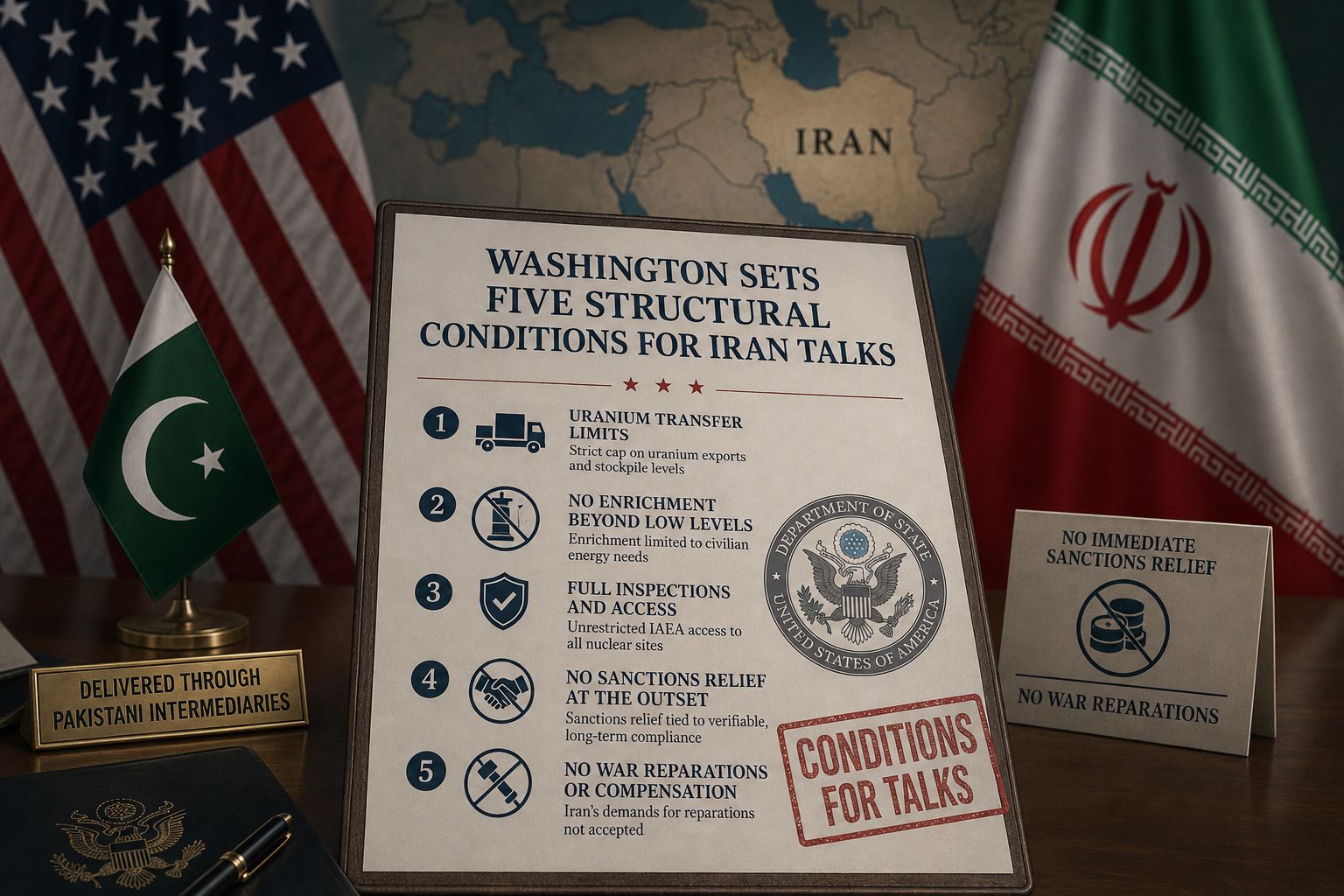
High-stakes diplomatic framework delivered through Pakistani intermediaries demands deep nuclear compromises and excludes immediate sanctions relief or war reparations.
Publication Date: May 18, 2026
Last Updated: May 18, 2026
Byline: Global War News Editorial
The United States government has presented Iran with five strict structural prerequisites to move forward with negotiations aimed at securing a permanent resolution to the regional war. The comprehensive diplomatic parameters, delivered via Pakistani mediators, outline a highly conservative American position that leaves narrow room for immediate economic or political concessions.
According to a detailed report published on May 17, 2026, by Iran’s semi-official Fars news agency, the Trump administration’s proposal focuses heavily on neutralizing Tehran’s nuclear capabilities and capping its regional strategic leverage. The disclosure of the American text follows weeks of stagnant indirect communications in Islamabad, where negotiators have attempted to transition a fragile, Pakistani-mediated ceasefire into a binding peace treaty.
The publication of Washington’s five terms has triggered sharp pushback from the political establishment in Tehran, where state-affiliated media networks characterized the document as an attempt to extract sweeping concessions without offering equivalent structural relief. The deepening diplomatic impasse coincides with a notable escalation in public rhetoric, with US President Donald Trump warning via social media that time is rapidly expiring for a diplomatic settlement.
The Five Preconditions Outlined by the United States
The document transmitted to Iranian negotiators establishes concrete limits across the nuclear, financial, and operational spheres. According to the disclosures carried by Fars and subsequent regional press tracking, the five core American demands are:
- Nuclear Facility Consolidation: The United States demands that Iran be permitted to keep only a single civilian nuclear facility operational, requiring the systematic shutdown or repurposing of all other existing atomic research and enrichment sites.
- Enriched Uranium Transfer: Tehran must physically transfer 400 kilograms of its enriched uranium stockpile directly into the custody of the United States or a designated international third party.
- Restriction on Frozen Assets: The Trump administration explicitly rejects the immediate release of Iranian state funds held in international accounts, stipulating that the United States will withhold the release of even 25 percent of Iran’s frozen assets during the initial phases of engagement.
- Exclusion of War Damages: The United States completely refuses to pay any financial compensation, reparations, or assume liability for infrastructural and material damages incurred within Iran during the high-intensity aerial campaigns earlier this year.
- Linkage of Frontline Actions: The permanent cessation of military operations across all regional theaters is strictly conditioned on the successful outcome and final verification of the comprehensive negotiation process, rather than serving as an unconditional precursor to the talks.
The Iranian Counter-Proposal and the Maritime Gridlock
The response from the Iranian leadership has been unyielding. The semi-official Mehr news agency reported that the Supreme National Security Council views the American terms as an attempt to secure strategic outcomes that Washington and its allies could not fully achieve through air superiority alone.
In response to the American framework, Tehran reinforced its own set of five “confidence-building measures,” which it insists must be executed before it participates in a second round of formal ministerial talks in Islamabad. Sourced via the Iranian Foreign Ministry, these requirements include the immediate lifting of all anti-Iran primary economic sanctions, the full return of frozen financial assets, and binding legal guarantees for reconstruction compensation.
Furthermore, a significant structural point of contention remains the administration of global energy channels. Iran’s counter-proposal demands formal American recognition of its sovereign right to regulate and administer commercial shipping through the Strait of Hormuz, where Tehran has recently attempted to institute an independent maritime transit fee system. This position directly challenges the active naval blockade enforced by the US Seventh Fleet under “Operation Economic Fury,” which has restricted Iranian crude oil exports since mid-April.
Context and Background: From “Epic Fury” to the Islamabad Standoff
The current crisis traces back to February 28, 2026, when a collapse in indirect diplomatic tracks triggered the re-imposition of sweeping international sanctions, culminating in an intensive 40-day aerial campaign codenamed “Epic Fury” by Western forces. The strikes caused substantial damage to Iranian air defense installations and command networks before a temporary ceasefire was negotiated on April 8 through the personal mediation of Pakistani Prime Minister Shehbaz Sharif and Field Marshal Asim Munir.
While the initial truce halted wide-scale urban bombardment, subsequent direct working groups convened in Islamabad between April 11 and 13 failed to establish a shared political baseline. President Trump extended the ceasefire indefinitely to allow for the exchange of written drafts, but both administrations have consistently maintained opposing views on the limits of strategic compromise.
The volatility of the current truce was underscored on May 17, when a hostile drone strike targeted an auxiliary electrical generator on the outer periphery of the United Arab Emirates’ Barakah Nuclear Power Plant. While UAE defensive systems intercepted two other inbound assets, the localized infrastructure damage has heightened international concerns regarding the security of regional civic installations while formal diplomacy remains frozen.
Analysis: The Dynamics of Absolute Deterrence
Observers note that the five preconditions set by the United States reflect a calculated gamble by the Trump administration that prolonged economic strangulation will force a structural shift in Tehran’s negotiation strategy. By demanding the physical transfer of 400 kilograms of enriched material and blocking access to liquid capital, Washington is seeking to structurally lock in a non-proliferation status quo before altering its naval blockade posture.
However, the rigidity of these demands presents distinct operational complications. For the political leadership in Tehran, an unconditional surrender of its nuclear stockpile and the abandonment of financial compensation claims represent terms that are highly difficult to reconcile with domestic survival narratives.
Consequently, the strategy of maximum coercion risks producing an absolute diplomatic deadlock. If the Iranian government determines that the Islamabad track offers no viable mechanism for economic relief or sovereign face-saving, the incentive to maintain the current maritime restrictions will diminish, potentially prompting a return to active kinetic skirmishes along the Persian Gulf coastline to force a revision of the American terms.
What to Watch
The critical indicator for the trajectory of the crisis will be whether Pakistan’s diplomatic corps can formulate a compromise text capable of bridging the gap between the American five-point framework and Iran’s structural counter-demands.
In the immediate term, global commodity markets will closely monitor the operational status of the Strait of Hormuz. Any physical attempt by the US Navy to intercept commercial vessels attempting to comply with Iran’s proposed maritime toll system, or any retaliatory deployment of Iranian fast-attack craft, will likely signal the formal termination of the April 8 truce.
Source Disclosure Note: This report is compiled from official public statements issued by US President Donald Trump and Vice President JD Vance. Iranian government positions and technical counter-terms are sourced from official briefings transmitted by the semi-official Fars, Mehr, and ISNA news agencies, alongside formal press releases from the Pakistani Ministry of Foreign Affairs. Additional military and economic tracking data is drawn from published briefings by the House of Commons Library and independent wire reporting via Reuters and Bloomberg.
This article is based on publicly available reporting from named international news agencies and attributed official statements. All claims about ongoing events are attributed to their original sources. Analysis sections represent the editorial interpretation of reported facts and do not constitute advocacy for any party to the described conflict. AI tools may be utilized for image generation to assist in explaining complex concepts, as well as for refining grammar, spelling, and other linguistic enhancements. However, all original content is produced, fact-checked, and revised by the editorial team. This publication does not take political positions on active military conflicts.