
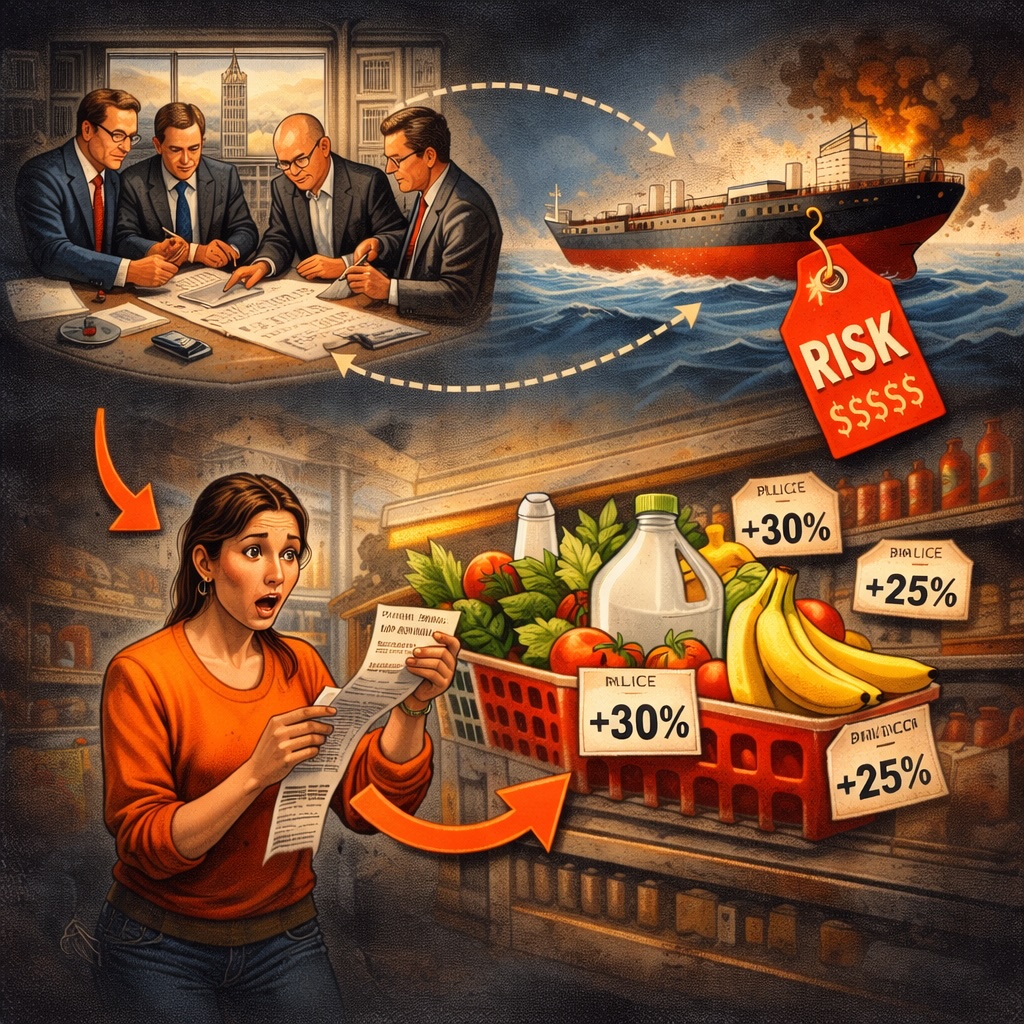
A group of underwriters in London reprices risk for a tanker in the Gulf. Within weeks, the cost lands on a supermarket shelf thousands of miles away. Here is how that chain works, and why it matters wherever you live.
Published: 7 April 2026 | Last Updated: 7 April 2026
Global War News Editorial
You have probably seen the headlines. The Strait of Hormuz is disrupted. Shipping costs are climbing. Fuel, food, and fertiliser are getting more expensive in markets from South Asia to East Africa to Southern Europe. But the coverage rarely explains the mechanism connecting a narrow waterway between Iran and Oman to a higher electricity bill or a more expensive bag of flour.
Part of the answer is obvious: a quarter of the world’s seaborne oil and roughly a fifth of its liquefied natural gas passes through that strait, according to the International Energy Agency. When ships stop moving through it, energy gets more expensive for everyone who depends on it.
But there is a less visible piece of the chain that most reporting skips entirely. Before a single barrel of oil is blocked, before any government announces rationing, a set of financial decisions made in the insurance markets of London and elsewhere has already determined whether ships will move at all. Those decisions are called war risk pricing, and understanding them explains a great deal about how conflict translates into cost.
What War Risk Insurance Is
Standard marine insurance covers the risks that come with operating a ship in normal conditions: storms, mechanical failure, collisions, cargo damage. What it does not cover is what happens when a missile hits your vessel, a mine punctures its hull, or a military force seizes it at gunpoint. For that, shipowners need a separate class of cover called war risk insurance.
War risk insurance protects shipowners against losses caused by political violence and military conflict. Standard marine policies normally exclude these risks. PropertyCasualty360 War risk cover fills that gap.
War risk insurance is typically separated into categories. War Risk Hull covers physical loss or damage to the vessel itself, including damage from missiles, shells, mines, torpedoes, and sabotage. It also covers capture and seizure, situations where a sovereign state or armed group detains a vessel even if no physical damage occurs. PropertyCasualty360
The second category covers liability. Protection and Indemnity clubs, known as P&I clubs, cover third-party liabilities such as oil spills or crew injury in normal operations, but they exclude war perils from standard cover. Lloyd’s List Shipowners must therefore purchase separate war risk liability extensions to cover what happens to third parties if their vessel is caught in a conflict.
The third category covers the cargo itself. Cargo cover is separate from hull and P&I cover. It is a physical damage policy for the goods being carried. The cargo owner must purchase their own war cover for the goods, or risk being uninsured if the ship is damaged by a war peril. PropertyCasualty360
A ship moving through contested waters needs all three types of cover to operate. Without all three, ports refuse entry, banks withhold cargo financing, and charterers will not contract the vessel. This is not a preference. It is a structural requirement embedded in port regulations, lending covenants, and charter party agreements across the global maritime industry. The system is binary: insured vessels sail; uninsured vessels do not. Irregular Warfare
That last point is worth sitting with. A shipowner who cannot get insurance at an affordable rate does not simply absorb the cost and sail anyway. They stop sailing. The cargo does not move. And the chain from producer to consumer breaks.
Who Sets the Rates, and How
War risk insurance is not priced by governments. It is priced by private underwriters, primarily in the London market, through a structure that has operated in roughly its current form for more than two centuries.
Shipowners buy an annual hull war risk insurance policy, usually from a commercial provider, for a baseline price running to hundreds of thousands of dollars. This protects them against war, revolutions, terrorism, strikes, riots, and the catch-all term civil commotions. But underwriters retain the right to charge an additional premium for each transit through an area designated as high risk. These additional premiums can be as much as the underwriter sees fit. Lloyd’s List
The list of high-risk areas is not set by any military authority or government. The Joint War Committee, known as the JWC, is comprised of underwriting representatives from both the Lloyd’s and the International Underwriting Association company markets, acting on behalf of those engaged in writing marine hull war business within the London market. The committee is advised by independent senior advisors and issues what are called Listed Areas, comprising those regions deemed to present enhanced risks. LMA
The JWC meets quarterly to review areas it considers high risk for merchant vessels exposed to war, strikes, terrorism, and related perils. Its guidance is watched closely and influences underwriters’ considerations and insurance premiums. PropertyCasualty360
When a region is added to the Listed Areas, every shipowner whose vessel enters those waters must notify their insurer and pay an additional premium, known as an AP, for that specific voyage. The hull war risk market has a well-understood notification mechanism built into shipowners’ war contracts, which allows war premiums to remain very low in peacetime but be renegotiated when risk in a region increases. ReinsuranceNe.ws
The rates themselves are negotiated individually between each shipowner’s broker and the underwriters willing to take the risk. Every war risk contract is bespoke. Owners who buy other marine insurance classes from the same insurer can often negotiate better rates on war risk. Every quote factors in the owner’s claims record and the commercial leverage that comes from managing large fleets. Lloyd’s List
How Rates Move During a Crisis
In normal times, war risk premiums are low enough that they barely register as a cost for most shipping operations. Before the current Middle East crisis, rates had clustered in the 0.15 to 0.25 percent of hull value bracket, and competitive pressures from excess market capacity had even pushed them lower in the preceding period. Lloyd’s List
When conflict escalates, that changes rapidly. Hormuz premiums had already risen 60 percent above their 2024 baseline by mid-2025, before the most recent escalation. This early movement occurred months before major strikes began, demonstrating that insurance markets tend to price conflict risk ahead of the events themselves. Irregular Warfare
After the coordinated US-Israeli strikes on Iran in late February 2026, war risk premiums surged fivefold within 48 hours, major marine insurers terminated existing coverage and offered replacements at dramatically higher rates, and the Lloyd’s Joint War Committee redesignated the entire Arabian Gulf as a conflict zone. Irregular Warfare
In practical terms, the numbers became very large very fast. A hypothetical five-year-old very large crude carrier currently worth around $138 million could face indicative insurance costs of $10 million to $14 million for a single voyage through the Strait of Hormuz, to the charterer’s account rather than the owner’s. Lloyd’s List For context, the same voyage would have cost a fraction of that sum in early 2024.
Ships with a perceived American, British, or Israeli connection have faced premiums approximately three times higher than vessels without those associations, as underwriters price the additional targeting risk that Iran has indicated for those vessels. Lloyd’s List
The historical precedent helps frame how severe the current situation is. During the Iran-Iraq Tanker War of the 1980s, roughly 540 vessels were attacked and insurance rates tripled at their peak, yet shipping through the Strait of Hormuz never fully ceased. Research from the Strauss Center at the University of Texas found that even during the 1990 Gulf War and 2003 Iraq invasion, coverage remained available, with rates peaking at 3.5 percent of hull value in 2003 before falling back within months. Insurance Business What distinguishes the current crisis is that two years of Houthi attacks in the Red Sea had already strained global war risk capacity before escalation arrived.
The Red Sea Precedent: A Ratchet That Didn’t Fully Release
The current Hormuz crisis did not arrive without warning. The Red Sea corridor, which runs from the Gulf of Aden to the Suez Canal and carries a substantial share of global container trade, had been under sustained attack from Houthi forces aligned with Yemen’s Ansar Allah movement since late 2023.
War risk premiums for Red Sea transits surged twentyfold from late 2023, while transit volumes fell 65 percent from 2023 levels by mid-2025. Insurance Business The critical lesson from that episode is what happened afterward. The Red Sea crisis never produced systematic P&I club withdrawal, only premium escalation. But premiums rose rapidly in response to attacks and declined slowly, if at all, even after weeks without incidents. Analysts concluded that rates would normalise only when sustained incident-free transit rebuilt actuarial confidence. Substack
In other words, the insurance market operates with a ratchet effect: costs go up fast and come down slowly. By the time the Hormuz crisis arrived in early 2026, the global war risk market had already absorbed two years of elevated Red Sea losses. Underwriters had taken a beating from a string of total losses inflicted on merchant shipping by Houthi attacks in 2025. Some underwriters believed the class lost money in that year. Lloyd’s List A market already under strain had less capacity to absorb new shocks.
What Happens When Premiums Become Prohibitive
There is a point at which premium increases do not simply raise costs. They stop ships from sailing at all.
Transits of all vessel types through the Strait of Hormuz fell 81 percent in early March 2026 compared to the same period the prior week. Just over one million deadweight tonnes of traffic was tracked passing through the chokepoint on March 1. The average figure in January had been 10.3 million deadweight tonnes. Lloyd’s List
This was not a physical blockade. While the strait remains legally open to international navigation, the sudden escalation in the conflict materially altered the risk landscape. The closure of the Strait of Hormuz was achieved to a large degree through fear tactics and the commercial response to them, as one maritime security consultant described it. Lloyd’s List
Harry Vafias, whose family group owns or manages a fleet of approximately 100 ships spanning tankers, bulkers, and liquefied petroleum gas carriers, said: “For the time being there is no insurance for going through the Strait of Hormuz and nobody is going to do that. You would have to be crazy to do it, especially without insurance.” Lloyd’s List
When ships cannot move through a route, carriers impose surcharges on those that do move through alternative routes, passing costs directly to cargo owners. Shipping giant Hapag-Lloyd implemented a War Risk Surcharge of up to $3,500 per container as of March 2, 2026. PropertyCasualty360 That surcharge does not stay with the shipping line. It moves through the supply chain, absorbed partly by importers, partly by distributors, and eventually, at least in part, by consumers.
Analysis: How a London Premium Reaches a Supermarket Shelf
The following section represents editorial analysis of reported facts and should be read as such.
The chain from underwriter to consumer is longer than most people realise, and each link adds friction.
A war risk premium increase raises the cost of a single voyage. That cost is typically charged to the charterer, the company that has hired the ship to carry a specific cargo. The charterer, an oil major, a commodity trader, or a food importer, builds that cost into the price at which they sell the cargo when it arrives. The importer in the destination country pays more for the goods. Their distributor prices accordingly. The retailer adds their margin. The consumer pays more at the till.
But the voyage insurance cost is only one part of what changes. When ships are rerouted, as many have been since late 2023 to avoid the Red Sea, voyages become longer. A ship that previously transited the Suez Canal now sails around the Cape of Good Hope, adding roughly ten days to a typical Asia-to-Europe journey. More days at sea means more fuel burned. More fuel burned means higher operating costs. Those costs also flow through the chain.
There is a third effect that gets less attention. When war risk cover is withdrawn or restricted, operators face compressed decision timelines with no good options. Routes around the Cape of Good Hope add weeks to voyage times, and significant fuel costs while waiting for diplomatic clarity are not commercially feasible. MultiModal UK The result is a shortage of available shipping capacity in affected trade lanes. Less supply of shipping capacity, with the same demand for goods, pushes freight rates higher independently of what any insurer is charging.
For a country like Sri Lanka, these pressures compound each other. Based on 2025 import data, 39.3 percent of Sri Lanka’s imports, worth approximately $8.3 billion, are directly exposed to rising commodity prices. Of this, $3.7 billion are petroleum products including crude oil, liquefied petroleum gas, and refined fuel. Ips Sri Lanka does not produce its own oil. It cannot replace the supply easily from other corridors. Sri Lanka imports 60 percent of its energy needs, much of it through the strait, and has no storage capacity beyond one month’s consumption needs. Al Jazeera
For a reader in Europe, North America, or East Asia, the exposure is different but still real. Higher oil prices affect manufacturing costs, transport costs, and agricultural inputs globally. According to Hamza Ali Malik, Director of the Macroeconomic Policy Division at the UN’s Asia-Pacific development arm ESCAP, the most immediate economic impacts are considerable increases in freight costs and oil, gas, and fertiliser prices, and he warned that higher inflation, weaker exports, and rising debt risks are likely to follow. UN News
The fertiliser channel deserves particular attention because it is less visible than fuel prices but carries significant consequences. The Gulf region is a key producer of nitrogen fertilisers, which depend primarily on natural gas burned at high pressure. About one-third of global seaborne trade in fertilisers typically passes through the Strait of Hormuz. Carnegie Endowment for International Peace When that fertiliser stops moving, the cost does not arrive at the farm immediately. It arrives at the farm months later, when planting decisions are being made and input costs have risen. Then it arrives at the grain market. Then at the food processor. Then at the retail shelf.
FAO Chief Economist Máximo Torero warned that fertiliser prices could average 15 to 20 percent higher in the first half of 2026 if the crisis persists, and that farmers are facing a dual cost shock: more expensive fertilisers alongside rising fuel costs affecting the entire agricultural value chain including irrigation and transport. FAO
What the Insurance Market Is Actually Doing Right Now
A common misconception in the current crisis is that insurers have simply abandoned the market. The Lloyd’s Market Association has pushed back strongly on that characterisation.
In a statement issued on 23 March 2026, the Lloyd’s Market Association said that war insurance remains available to cover insureds from war perils and is available within the Lloyd’s and London company market for vessels wishing to transit the Strait of Hormuz. The LMA stated that liability coverage through the P&I clubs is non-cancellable and remains reinsured in the London market. LMA
In a survey conducted among the main participants in the Lloyd’s marine war market in the week following the start of hostilities, 88 percent of respondents indicated they continue to have appetite to underwrite international hull war risks, and over 90 percent expressed appetite to underwrite international cargo risks. LMA
The LMA’s position is that the problem is not insurance availability. The reason ships are not moving is not through a lack of insurance. It is a question of the risk to crew and vessel safety being assessed by ship masters and owners as too high. LMA
Lloyd’s chair Sir Charles Roxburgh stressed that the market remained open and was working with UK, US, and international partners on a coordinated response. MultiModal UK
That said, cover being technically available and cover being commercially viable are different things. Most marine insurers acknowledge that cover is still on offer from Lloyd’s, the London market, and elsewhere, even if it is now hugely more expensive to reflect the hugely higher risk. Lloyd’s List When the effective rate for a Hormuz transit reaches 10 percent of hull value or more, as some market sources have indicated for certain vessel types, the practical effect on vessel movement is similar to a market that has shut.
What to Watch
The duration of this disruption matters enormously. The Red Sea experience showed that insurance markets do not normalise quickly once they have been shocked. If premium elevation required two years to partially normalise in a lower-intensity Red Sea environment, a higher-intensity Hormuz disruption should logically require longer, not shorter, to resolve. Substack
For importing nations, particularly those with limited foreign currency reserves and minimal strategic stockpiles, the question is whether diplomatic resolution or alternative supply arrangements arrive before domestic price pressures become difficult to manage. Sri Lanka’s vulnerability to external shocks is particularly acute due to its heavy reliance on imported energy, fertiliser, and essential goods, with economic buffers that remain weak following the 2022 financial crisis. Eurasia Review
For readers in economies with more insulation from supply shocks, the question is whether elevated freight costs and insurance-driven supply disruptions persist long enough to feed through into broader consumer price inflation. Historical evidence from the 2022 Ukraine crisis, when fuel prices rose above $100 per barrel and remained there for roughly 90 days before the high energy cost produced an extended inflation episode lasting into 2023, Ips suggests the transmission can be slow but is eventually felt broadly.
According to UNCTAD, economic impacts globally and regionally will depend on the duration, intensity, and geographic scope of the tensions, and continued monitoring is essential to assess evolving risks and their potential impacts. UNCTAD
That is where things stand. Insurance markets are repricing risk in real time. Ships are making commercial calculations about whether to sail. Cargo is being delayed or rerouted. And the cost of all of it is working its way through supply chains that span the entire globe.
Sources Used
Lloyd’s Market Association (LMA), market statement, 23 March 2026. Available at lmalloyds.com.
Lloyd’s List, “US, UK and Israeli ships charged three times more than others for Middle East war cover,” 3 March 2026.
Lloyd’s List, “Gulf war risk premiums topping double-digit millions of dollars per trip,” March 2026.
Lloyd’s List, “Strait of Hormuz transits collapse as shipping’s risk appetite is tested,” March 2026.
Lloyd’s List, “No, P&I clubs have not cancelled war risk cover,” March 2026.
Lloyd’s List, “Shipowners weigh up risk of dark Hormuz transits,” 3 March 2026.
Insurance Business Magazine, “Major event response activated as Middle East crisis rattles insurers,” 4 March 2026.
Irregular Warfare Center, “The Insurance Weapon: How Commercial Risk Logic Became an Irregular Warfare Tool at Hormuz,” March 2026.
Multimodal.org.uk, “Hormuz crisis: hull and cargo insurance and what it means for UK trade,” March 2026.
Property Casualty 360, “Maritime War Risk Insurance in the 2026 Iran Crisis,” 18 March 2026.
Property Casualty 360, “Joint War Committee,” background reference.
Seaemploy.com, “War Risk Insurance 2026: Statements from P&I Clubs,” 4 March 2026.
Institute of Policy Studies, Sri Lanka (IPS), “Import Price Shocks of the Hormuz Crisis 2026: How Will This Affect Sri Lanka?”, 20 March 2026. Published via TalkingEconomics, Lanka Business Online, and The Island.
Al Jazeera, “Sri Lanka braces for new economic crisis as war on Iran continues,” 27 March 2026.
UN News / ESCAP, “Middle East war shockwaves ripple through Asia-Pacific fuel and supply chains,” 19 March 2026.
FAO, statement by Chief Economist Máximo Torero on global agrifood implications of the 2026 Middle East conflict, March 2026.
Carnegie Endowment for International Peace, “Fertilizer isn’t getting through the Strait of Hormuz, which could lead to a global food crisis,” March 2026.
UNCTAD, “Strait of Hormuz disruptions: Implications for global trade and development,” March 2026.
Institute of South Asian Studies (ISAS), “Sri Lanka’s Impending Energy Crisis: Implications For Political Stability,” 3 April 2026. Published via Eurasia Review.
International Energy Agency (IEA), referenced in IPS and UNCTAD reports for Hormuz throughput data.
This article is based on publicly available reporting from named international news agencies and attributed official statements. All claims about ongoing events are attributed to their original sources. Analysis sections represent the editorial interpretation of reported facts and do not constitute advocacy for any party to the described conflict. This publication does not take political positions on active military conflicts.
The featured image, if displayed, was generated using AI image generation tools and does not depict any real event or individual. Final editorial review, fact-checking, and publication approval by the Global War News editorial team. All data points have been verified by human analysts against named primary and secondary sources prior to publication.