
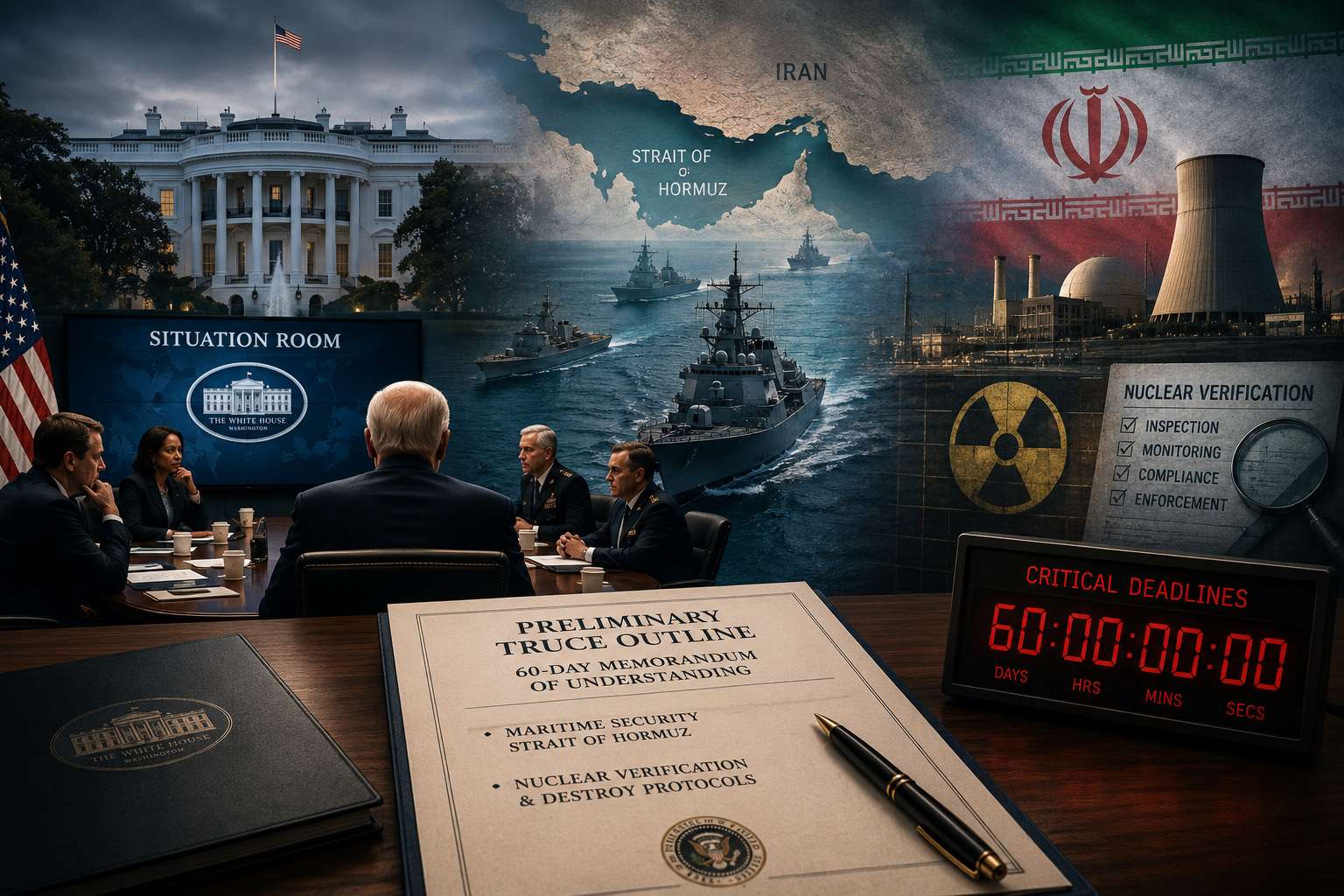
Behind the closed-door Situation Room briefings, a 60-day memorandum of understanding takes shape, balancing immediate maritime security in the Strait of Hormuz against deep-seated nuclear verify-and-destroy protocols.
Publication Date: June 2, 2026
Last Updated: June 2, 2026
Byline: Global War News Editorial
WASHINGTON: The White House has finalized a preliminary framework for a potential 60-day truce with Iran following an intensive series of national security meetings in the Situation Room. The draft memorandum of understanding (MOU) represents the most significant diplomatic movement since the outbreak of major hostilities in late February, though administration officials emphasize that a final presidential signature hinges on unresolved enforcement protocols.
According to reports from the Associated Press and regional diplomatic sources, the core of the proposed framework requires Iran to halt its current nuclear enrichment activities and eventually surrender its stockpile of highly enriched uranium (HEU). In exchange, the United States would implement a phased easing of its naval blockade on Iranian ports, granting conditional sanctions waivers to allow managed oil exports.
However, the diplomatic path remains highly volatile. On June 1, Iran’s state television warned that the probability of the current fragile ceasefire ending remains high if parallel regional hostilities are not effectively contained. Simultaneously, the state-affiliated Tasnim news agency reported that the Iranian negotiating team had temporarily paused the direct exchange of messages through Pakistani and Qatari mediators, citing ongoing military operations in neighboring Lebanon.
The Terms of the 60-Day Framework
The negotiated text establishes a multi-step roadmap designed to transition from an unstable cessation of hostilities into structured, long-term peace talks. The primary mechanisms under negotiation focus on three distinct areas:
- Nuclear Material Disposal: The International Atomic Energy Agency (IAEA) reported that Iran possesses 440.9 kilograms of uranium enriched to 60% purity—a short technical step from weapons-grade material. Under the draft terms, this “nuclear dust” would be unearthed and neutralized under joint supervision involving the U.S., Iran, and the IAEA, with remaining portions potentially transferred to a neutral third country such as Russia.
- Maritime Reopening: The framework outlines a gradual reopening of the Strait of Hormuz to commercial shipping. The strait, which handles roughly 20% of global daily oil supplies, was restricted early in the conflict when Iran established the Persian Gulf Strait Authority to collect transit tolls—an entity subsequent U.S. sanctions sought to disable.
- Financial Reconstruction vs. Assets: A highly sensitive proposal developed by U.S. envoys Steve Witkoff and Jared Kushner explores the creation of a $300 billion international investment fund to rebuild Iranian infrastructure. This fund is intended to address Tehran’s demands for war reparations without utilizing direct U.S. taxpayer appropriations, relying instead on contributions from Gulf Arab states.
Verification and Timing Deadlocks
Despite the structural finalization of the text, deep institutional distrust between Washington and Tehran continues to delay formal execution. According to an assessment published by the Soufan Center on June 1, the Trump administration remains concerned that front-loading financial concessions or unfreezing assets will diminish Washington’s leverage to enforce long-term nuclear restrictions.
Tehran, conversely, has demanded the immediate release of its frozen foreign assets as a prerequisite for implementation. The issue is further complicated by political transitions inside Iran. The country’s Supreme Leader, Mojtaba Khamenei, who assumed leadership following his predecessor’s death in the opening salvos of the war, has not made a public appearance since March 8, leaving Western intelligence agencies uncertain as to who holds final domestic clearance authority over the diplomatic text.
In response to the unresolved items, the U.S. Navy Central Command issued a fresh notice to mariners warning that defensive operations in the Persian Gulf remain fully active. U.S. officials stated that any vessels observed engaging in or supporting mine-laying activities in shipping lanes would be targeted immediately, signaling that a heightened military posture will be maintained until an accord is officially signed.
ANALYSIS: The Leverage Trap
The finalization of this MOU text highlights a classic diplomatic dilemma where the mechanics of verification conflict with the necessity of immediate de-escalation. For the White House, the primary objective is securing a verifiable halt to Iranian nuclear enrichment before any financial relief is granted. The administration appears determined to avoid the structure of the 2015 Joint Comprehensive Plan of Action (JCPOA), which it previously criticized for front-loading economic benefits.
For Iran, the priority is immediate economic survival. The combination of a naval blockade and broad trade sanctions has severely restricted oil revenue, making the unfreezing of foreign assets an absolute domestic necessity. By conditioning the reopening of the Strait of Hormuz on compliance, the U.S. is utilizing its primary maritime advantage, but this strategy risks a breakdown if hardline factions in Tehran decide that the economic relief offered is too distant or heavily policed.
Observers note that the 60-day window is not a permanent peace treaty, but a cooling-off period intended to establish basic structural trust. If regional proxy escalations or verification disputes disrupt the current phase, both nations possess the mobilization assets required to resume active hostilities within a matter of hours.
What to Watch Next
As the critical negotiation deadline approaches, three specific factors will determine whether the draft MOU transitions into an active agreement:
- Clarification of Leadership Authority: Whether a clear directive emerges from Tehran confirming that the negotiating team led by Mohammad Bagher Ghalibaf has the institutional authority to bind the state to nuclear concessions.
- The Strait Toll Dispute: Whether the U.S. Navy and the Persian Gulf Strait Authority can reach a functional compromise on commercial transit rules without triggering defensive engagement.
- Regional De-escalation Links: Whether diplomatic channels can successfully isolate the U.S.-Iran bilateral text from ongoing cross-border operations involving external regional allies.
Source Disclosure Note: This report utilizes verified data from the International Atomic Energy Agency (IAEA), official statements transmitted via the Iranian state-affiliated Tasnim news agency, public military notices from U.S. Navy Central Command, and independent regional reporting from the Associated Press, Reuters, and the Soufan Center.
This article is based on publicly available reporting from named international news agencies and attributed official statements. All claims about ongoing events are attributed to their original sources. Analysis sections represent the editorial interpretation of reported facts and do not constitute advocacy for any party to the described conflict. AI tools may be utilized for image generation to assist in explaining complex concepts, as well as for refining grammar, spelling, and other linguistic enhancements. However, all original content is produced, fact-checked, and revised by the editorial team. This publication does not take political positions on active military conflicts.