
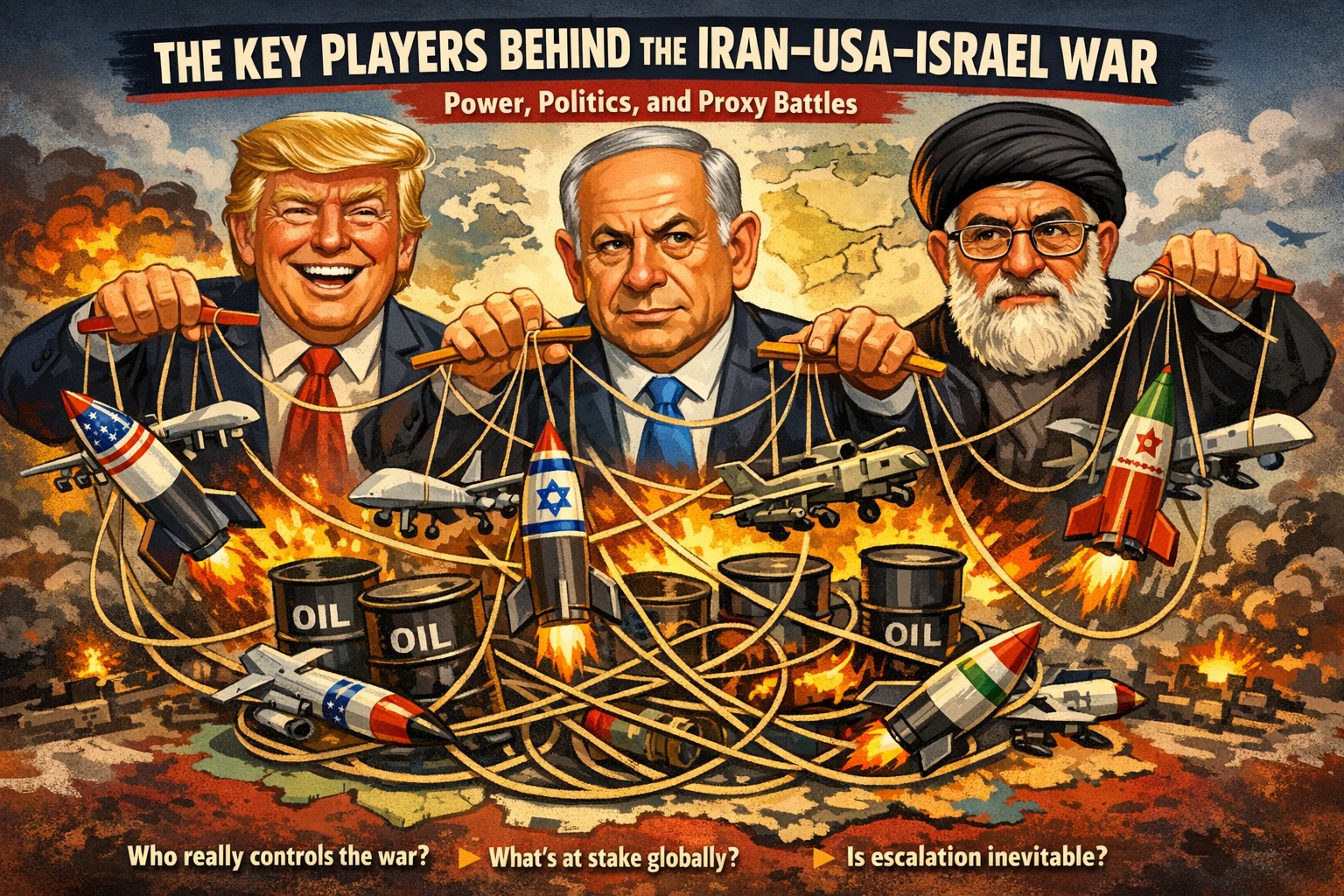
A guide to the individuals and organisations driving the conflict, from the Oval Office and the Knesset to Tehran’s revolutionary institutions, the Gulf capitals caught in the middle, and the armed groups fighting on Iran’s behalf across the region.
Global War News Editorial. Published: 5 April 2026 | Last updated: 5 April 2026
The conflict that began on 28 February 2026 involves not one adversary facing another, but a dense web of states, institutions, armed movements, and individual leaders, each with their own calculations, constraints, and goals. Understanding who the players are, what they actually control, and what they want is necessary for making sense of how the war has developed and where it might go.
This guide covers the principal parties in order of their centrality to the conflict.
Donald Trump, President of the United States
Donald Trump, 79, returned to the presidency in January 2025 and authorised the joint US-Israeli strikes on Iran that began the current war on 28 February 2026. Those strikes killed Iran’s Supreme Leader Ali Khamenei on the opening day of operations.
Trump’s approach to Iran has been characterised by what his administration described as maximum pressure: comprehensive sanctions, military threats, and a stated refusal to accept Iranian nuclear capability under any terms. He withdrew the United States from the 2015 nuclear deal during his first presidency in 2018, a decision that has been directly cited by non-partisan analysts as the primary cause of Iran’s subsequent stockpiling of enriched uranium.
In the current conflict, Trump has provided the military weight that Israel alone could not deploy. The B-2 Spirit bombers and Massive Ordnance Penetrators used to strike Fordow and Natanz are exclusively American assets. Without US involvement, the June 2025 Israeli strikes had already set back Iran’s nuclear programme, but had not resolved the underlying strategic question.
Trump’s public statements on the conflict have at times contradicted each other. He has at different moments described the war as nearly finished, demanded Iran’s unconditional surrender, warned of seizure of Iran’s enriched uranium stockpiles, and said there was “practically nothing left” to target. According to reporting by the LSE Business Review, analysts have read these statements not as a coherent strategy but as a short-term effort to shape expectations and limit economic shock while military pressure continues. Trump told Fox News on 1 March 2026 that 48 senior Iranian leaders were killed in the initial US-Israeli strikes.
The President’s relationship with Gulf state leaders has complicated the conflict’s diplomatic landscape. Several Gulf leaders had urged Trump not to launch the war. According to the Atlantic Council, Trump told CNN that Iranian attacks on Gulf countries were “the biggest surprise” of the conflict so far, apparently expecting the Gulf states would avoid being drawn in.
Benjamin Netanyahu, Prime Minister of Israel
Benjamin Netanyahu, 76, has been Israel’s dominant political figure for most of the past three decades, serving multiple terms as prime minister. He has defined Iran’s nuclear programme as an existential threat to Israel since at least the early 1990s, and has consistently argued that diplomacy has failed to neutralise that threat.
Israel launched Operation Rising Lion, the initial aerial assault on Iranian nuclear and military targets, on 13 June 2025. According to the Arms Control Association, those strikes were focused on over 100 targets, including senior members of the Iranian military and nuclear leadership. The second major campaign, in which US and Israeli forces struck jointly on 28 February 2026, killed Khamenei and opened the current phase of the war.
Netanyahu has publicly framed the operations as defensive necessity. “If not stopped, Iran could produce a nuclear weapon in a very short time,” he stated at the opening of the June 2025 campaign, according to the IAEA’s contemporaneous reporting.
Israel has a specific vulnerability in this conflict that the United States does not share to the same degree: it is within range of Iranian ballistic missiles, Lebanese Hezbollah’s rocket arsenal, and Houthi missiles from Yemen. Israeli air defence systems, including the Iron Dome and David’s Sling, have been active throughout the conflict. Israeli strikes have also targeted Hezbollah positions in Lebanon, adding a second front to the military operation.
Netanyahu’s political position at home has been contested throughout recent years. He has faced prolonged domestic protests over judicial reform policies and over the management of the 2023 Gaza war. The Iran military campaign commands broad political support within Israel, but the duration and cost of the conflict remain points of contention.
Marco Rubio, US Secretary of State
Marco Rubio, 54, took office as Secretary of State in January 2025. A Florida senator for over a decade before joining the administration, Rubio has been a consistent advocate of confrontational Iran policy, opposing the 2015 nuclear deal and supporting the maximum pressure sanctions regime.
As Secretary of State, Rubio has been the principal US diplomatic voice during the conflict, managing communications with Gulf partners, European allies, and the UN while military operations continued. His position, along with that of the broader Trump administration, has been that Iran was approaching nuclear capability that posed an imminent threat, a claim contested by some arms control experts who noted that while Iran had the fissile material in quantity, it had not demonstrated weapons assembly capability.
Rubio has also managed the diplomatic fallout with Gulf states that were struck by Iranian retaliatory missiles despite having sought to remain neutral. His public remarks have emphasised that the war is about long-term regional security, not merely Iran’s nuclear programme.
Ali Khamenei (1939–2026): The Man Who Defined the Islamic Republic
Ali Khamenei served as Supreme Leader of Iran from 1989 until his assassination on 28 February 2026, a tenure of 37 years. He was the longest-serving head of any major state when he died.
Understanding Khamenei is essential to understanding the conflict, because the entire structure of the Islamic Republic was, in practice, a structure built around him.
As supreme leader, Khamenei was the highest religious and political authority in the Islamic Republic. He commanded the armed forces, appointed the chief justice, supervised the state media, and controlled the Guardian Council, which has the power to vet electoral candidates and veto parliamentary legislation. In this capacity, Khamenei had the final say on foreign policy and different areas of domestic policy.
Khamenei came to power unexpectedly. He had served as president from 1981 to 1989, and was considered a relatively junior cleric when Ayatollah Khomeini, the founder of the Islamic Republic, chose him as successor in 1989. Over three decades in power he expanded both the role of the supreme leader and the institutional weight of the IRGC, which became the principal guarantor of the system’s survival.
On nuclear policy, Khamenei’s position was publicly ambiguous and privately complex. He issued a religious ruling, or fatwa, stating that nuclear weapons were forbidden under Islam. Whether this reflected genuine conviction or diplomatic positioning has been debated for decades. What is clear from IAEA documentation is that during his tenure, Iran’s enrichment programme expanded dramatically, particularly after 2019.
During the twelve-day war in June 2025, Khamenei provided input and issued directives on the succession process from inside his bunker after Israel killed several of his senior commanders and targeted some of his top advisers. He did not publicly name a successor before his death.
Mojtaba Khamenei: The New Supreme Leader
An election for the third supreme leader of Iran by the Assembly of Experts was held from 3 to 8 March 2026, following the assassination of Ali Khamenei on 28 February. Mojtaba Khamenei, son of Ali Khamenei, was announced as the new supreme leader on 9 March.
Mojtaba Khamenei, 56, is a Shia cleric who has never held formal government office. He has deep ties to the Islamic Revolutionary Guard Corps and to the Basij, the IRGC’s paramilitary volunteer force. His elevation was controversial on two grounds.
The first was constitutional legitimacy. Khamenei’s second son Mojtaba is a significant figure with strong links to the IRGC and the Basij. But given that the regime swept to power to replace the Iranian monarchy, the Shiite clerical establishment may want to avoid father-to-son succession.
The second was the manner of his selection. According to Iran International, the IRGC tried to appoint a new supreme leader quickly on 28 February, bypassing the formal electoral process. IRGC commanders then pressured Assembly of Experts members to vote for Mojtaba Khamenei as Supreme Leader with “repeated contacts and psychological and political pressure.”
As of April 2026, Mojtaba Khamenei has not appeared in public since his appointment. All communications attributed to him have been delivered through state television as written statements or read by announcers. The IRGC has established a strict security perimeter around him, restricting access to official information and effectively preventing direct communication between the Supreme Leader’s office and other branches of government. Requests from President Pezeshkian to meet the Supreme Leader have not been granted in recent days.
Whether Mojtaba Khamenei is governing in substance, or whether power has effectively shifted to the IRGC command structure, is one of the most consequential unanswered questions of the current conflict.
Masoud Pezeshkian: Iran’s President
Masoud Pezeshkian, born 29 September 1954, has served as president of Iran since 2024. He is distinguished from his predecessor in that he favours a nuclear agreement with the West and modest social and political reforms at home. He is the most reform-oriented president since Mohammad Khatami, under whom he served as minister of health from 2001 to 2005.
Pezeshkian came to power as a heart surgeon turned politician, with a background that included service in the Iran-Iraq War and decades in parliament representing a northwestern constituency. His presidency was defined from the start by a structural tension: he held reformist views in a system where reformists have historically been constrained by the supreme leader, the Guardian Council, and the IRGC.
He had sought to revive nuclear diplomacy with the United States before the June 2025 Israeli strikes. Following Israeli strikes in June 2025, tensions escalated into the twelve-day war during which an unsuccessful attempt on his life was made. He sustained minor injuries to his leg while escaping a strike on a meeting of the Supreme National Security Council he was attending.
Since the February 2026 strikes and Khamenei’s assassination, Pezeshkian has sat on the Interim Leadership Council and has emerged as the most visible diplomatic voice from the Iranian side, laying out Iran’s terms for ending the war: recognition of Iran’s legitimate rights, payment of reparations, and firm international guarantees against future aggression.
Despite being the president of a country in the midst of crisis, Pezeshkian has not had the highest of war profiles. His actual authority over military operations and strategic decisions is openly questioned. A recent attempt by Pezeshkian to appoint a minister was blocked by IRGC commander Ahmad Vahidi, who stated that under current wartime conditions, all critical and sensitive government positions must be selected and overseen directly by the IRGC.
On 1 April 2026, Pezeshkian penned an open letter to the American public, imploring Americans to “look beyond” what he characterised as “the machinery of misinformation” and asserting that Iran had never, in its modern history, chosen the path of aggression.
The Islamic Revolutionary Guard Corps: The State Within the State
The IRGC is not simply an army. Understanding it is essential to understanding how Iran actually functions, and how the current war is being prosecuted.
The Islamic Revolutionary Guard Corps is one of the most powerful and feared organisations in Iran, playing central roles in the country’s projection of power, internal security, and economy. Following the 1979 revolution, Iran’s clerical leaders created the IRGC outside, and as a counterweight to, the country’s traditional armed services, which they distrusted. It reports directly to the Supreme Leader, and its size and powers have expanded immensely. Among its many prominent military duties, the corps operates Iran’s formidable ballistic missile arsenal and oversees the Quds Force, an expeditionary arm that partners with Iran’s various regional affiliates, including Hamas and Hezbollah.
The IRGC controls about 50 percent of the Iranian economy and shadows the actual Iranian military. IRGC leaders say they are not even beholden by the Iranian constitution. They are beholden to whatever interpretation they have of what the 1979 revolution is.
The IRGC has five branches: ground forces, navy, aerospace force, the Basij paramilitary network, and the Quds Force. The navy is responsible for operations in the Persian Gulf and has direct control of the Strait of Hormuz closure. The aerospace force operates Iran’s ballistic missile arsenal, which has been used to strike US bases across the Gulf and Israeli territory. The Quds Force has for decades managed Iran’s relationships with proxy and affiliated armed groups across the region.
Despite more than two weeks of relentless airstrikes, US intelligence assessments said Iran’s regime would likely remain in place for now, weakened but more hard-line, with the IRGC exerting greater control. This assessment, reported by the Washington Post in mid-March 2026, reflected the paradox that military pressure on the system as a whole tends to consolidate power within its most hardened institution.
During the 2026 Iran war, the IRGC became the main dominant power in Iran, as IRGC commander Ahmad Vahidi insisted that all critical and sensitive leadership positions must be decided by the IRGC.
Hezbollah: Iran’s Oldest and Most Capable Proxy
Hezbollah is a Lebanese Shia political and military organisation with deep roots in Lebanon’s political system and a military capacity that has grown for four decades under Iranian sponsorship. It is not simply an Iranian proxy in the sense of a group that takes orders from Tehran. It has its own political base, its own social welfare network, and its own strategic interests, which frequently align with Iran’s but are not identical.
Hezbollah was created in the early 1980s during the Lebanese civil war, with direct involvement from the IRGC Quds Force. It has since grown into one of the most heavily armed non-state actors in the world, possessing an estimated arsenal of over 100,000 rockets and missiles of varying range, according to previous assessments by international security research institutes. Its military wing has fought in Syria, Iraq, and has conducted operations well beyond Lebanon’s borders.
The organisation was severely damaged in 2024 and early 2025, when Israeli operations killed its long-standing leader Hassan Nasrallah and several senior commanders, and degraded significant portions of its long-range missile stockpiles. Despite this, the organisation remained functional and has participated in the current conflict by launching missiles at Israeli territory. According to reporting by multiple outlets, Hezbollah framed its current operations as direct retaliation for Khamenei’s killing.
From an economic perspective, Hezbollah’s participation adds a second front for Israeli air defences and complicates any potential diplomatic resolution, since any ceasefire arrangement would need to address Hezbollah’s role as well as Iran’s direct military activity.
The Houthis: Yemen’s Wildcard
The Houthi movement, officially known as Ansar Allah, controls much of northern Yemen including the capital Sanaa, following its capture of the city in 2014. It is a Zaydi Shia Islamist organisation, though its ties to Iran should not be taken to mean it operates as a simple Iranian instrument.
Although the Houthis are backed by and allied with Iran, they are not a straightforward proxy, and they often prioritise their own domestic interests. And although Iran has supplied them with sophisticated ballistic missile technology, the group has also developed the ability to assemble and manufacture its own weaponry inside Yemen.
The Houthis played a similarly outsized role in upending global shipping between November 2023 and January 2025, when they attacked over 100 merchant vessels in the Red Sea in a campaign of solidarity with Palestinians during the Gaza war. The Defense Intelligence Agency reported that Houthi maritime terrorism resulted in a 90 percent drop in container shipping through the Red Sea.
The Houthis entered the Iran war on 28 March 2026, firing a barrage of ballistic missiles at southern Israel. Their military spokesperson stated the attacks would continue “until the aggression against all fronts of the resistance ceases.”
The Houthis’ strategic significance in 2026 is amplified by geography. With the Strait of Hormuz effectively closed because of the Iran war, Saudi Arabia is relying on its facilities along the Red Sea to maintain some oil exports. Absent the Red Sea route, Gulf oil flows could grind to a halt after a couple more weeks of war. The Houthis control the coastline that gives them the ability to threaten those Red Sea export routes.
The Houthis aim to raise the economic cost of the war by signalling a threat to the Red Sea. Participating in the conflict allows them to highlight that they remain an active part of Iran’s regional axis, while also improving their political position in Yemen and beyond.
The Gulf States: Caught Between Two Powers
Saudi Arabia, the UAE, Qatar, Kuwait, Bahrain, and Oman form the Gulf Cooperation Council. All six were drawn into the conflict against their stated wishes, when Iran’s retaliatory strikes targeted civilian and energy infrastructure across all GCC countries following the 28 February 2026 US-Israeli attack.
The Gulf states did not want this confrontation. In the weeks leading up to the attack, Oman had been mediating indirect talks between Washington and Tehran, with the Omani foreign minister declaring that peace was “within reach.”
Within the first 48 hours of the conflict, Iran targeted all the countries in the GCC, from the UAE, which suffered the brunt of hundreds of drones and missiles, to Saudi Arabia, Oman, Qatar, and beyond. Iran did not limit its strikes to US military bases; it also targeted civilian sites, including airports and hotels, followed by major oil and gas infrastructure.
The Gulf states’ subsequent shift in position has been significant. Following direct Iranian attacks on its territory, Saudi Arabia abandoned its declared position of neutrality and defined Iran as an existential threat, reserving the right to respond with military force.
The individual Gulf states have different interests and different exposures. Saudi Arabia hosts the East-West Crude Oil Pipeline whose Red Sea terminus at Yanbu has become the critical bypass route for oil exports that cannot move through Hormuz. The UAE, which normalised relations with Israel in 2020 through the Abraham Accords, suffered the heaviest Iranian drone and missile attack. Qatar hosts the al-Udeid air base, from which US military operations are conducted, making it a target despite its diplomatic role as a mediator. Oman has consistently advocated for a ceasefire and has been the principal back-channel for US-Iran indirect communication.
The war has eased, if not ended, the deepening rift between Saudi Arabia and the UAE, which now share anger at Tehran for attacking Gulf states despite their refusal to facilitate or support the US campaign.
Analysis: How the Power Map Has Changed
The following section is clearly labelled as editorial analysis and represents interpreted assessment of reported facts, not established fact.
The most consequential shift produced by the conflict so far is one that was not among the stated objectives of any party: the consolidation of effective power inside Iran within the IRGC, at the expense of both the presidency and, arguably, the nominal authority of the new supreme leader.
Pezeshkian, who represented the reformist current within the Islamic Republic and who had been pursuing nuclear diplomacy before the war began, has been progressively marginalised as wartime decision-making concentrates in military institutions. The IRGC’s blocking of his ministerial appointment, the reported denial of access to the new supreme leader, and the organisation’s direct management of the Strait of Hormuz operation all suggest a structural shift that may outlast the immediate conflict.
This matters for the question of how the war ends, because the most plausible diplomatic path runs through Pezeshkian or similarly inclined figures willing to accept a negotiated settlement. If effective authority rests with IRGC commanders whose institutional identity is defined by resistance to the United States and Israel, the conditions for a durable ceasefire are harder to construct.
The Gulf states’ position has also shifted in ways that will persist beyond any ceasefire. Iran’s decision to strike all six GCC countries despite their stated neutrality has, according to multiple analysts at the Arab Center, the Atlantic Council, and Chatham House, effectively ended the period of Saudi-Iranian détente that had followed their 2023 diplomatic normalisation. The Gulf states entered this conflict hoping to stay out of it. They have emerged with a fundamentally different threat assessment of their Iranian neighbour.
Whether that new assessment produces a more durable regional security architecture or a more volatile one depends on choices that have not yet been made.
Sources used in this article: Wikipedia, “2026 Iranian Supreme Leader Election,” updated April 2026; Carnegie Endowment for International Peace, “After Khamenei’s Death,” March 2026; CNN, “Who’s Running Iran Now That the Supreme Leader Is Dead?” March 2026; RAND Corporation, “Who or What Will Replace Iran’s Supreme Leader Ali Khamenei?” March 2026; Al Jazeera, “Iran Foreign Minister Suggests New Supreme Leader May Be Chosen Within Days,” March 2026; Wikipedia, “Masoud Pezeshkian,” updated April 2026; Britannica, “Masoud Pezeshkian,” updated April 2026; The Conversation, “Iran’s President Appeals to Americans,” April 2026; Time, “Iranian President Pens Open Letter to American People,” April 2026; Council on Foreign Relations, “The Islamic Revolutionary Guard Corps,” January 2026; Britannica, “Islamic Revolutionary Guard Corps,” updated April 2026; NPR, “How Iran’s Revolutionary Guard Is Woven Into the State’s Power Structure,” January 2026; The Week, “Iran’s Revolutionary Guard: Why It Is So Important,” March 2026; The Defense News, “Iran Power Shift: IRGC Takes Full Control,” April 2026; Washington Post, “US Intelligence Says Iran’s Regime Is Consolidating Power,” March 2026; Time, “Yemen’s Houthis Have Entered the Iran War,” March 2026; Al Jazeera, “Yemen’s Houthis Coordinate With Iran But Retain Independence,” April 2026; Atlantic Council, “Will the Houthis Join the Iran War?” March 2026; Arab Center DC, “The GCC States and the War on Iran,” March 2026; Atlantic Council, “The Gulf That Emerges From the Iran War Will Be Very Different,” March 2026; Times of Israel, “Gulf States Opposed War With Iran, Most Are Now Pushing to Keep the Fight Going,” March 2026; Chatham House, “Should the Gulf Arab States Join the War Against Iran?” March 2026; MEMRI, “Shift in Saudi Arabia’s Declared Position on Iran War,” March 2026.
This article is based on publicly available reporting from named international news agencies and attributed official statements. All claims about ongoing events are attributed to their original sources. Analysis sections represent the editorial interpretation of reported facts and do not constitute advocacy for any party to the described conflict. This publication does not take political positions on active military conflicts.