
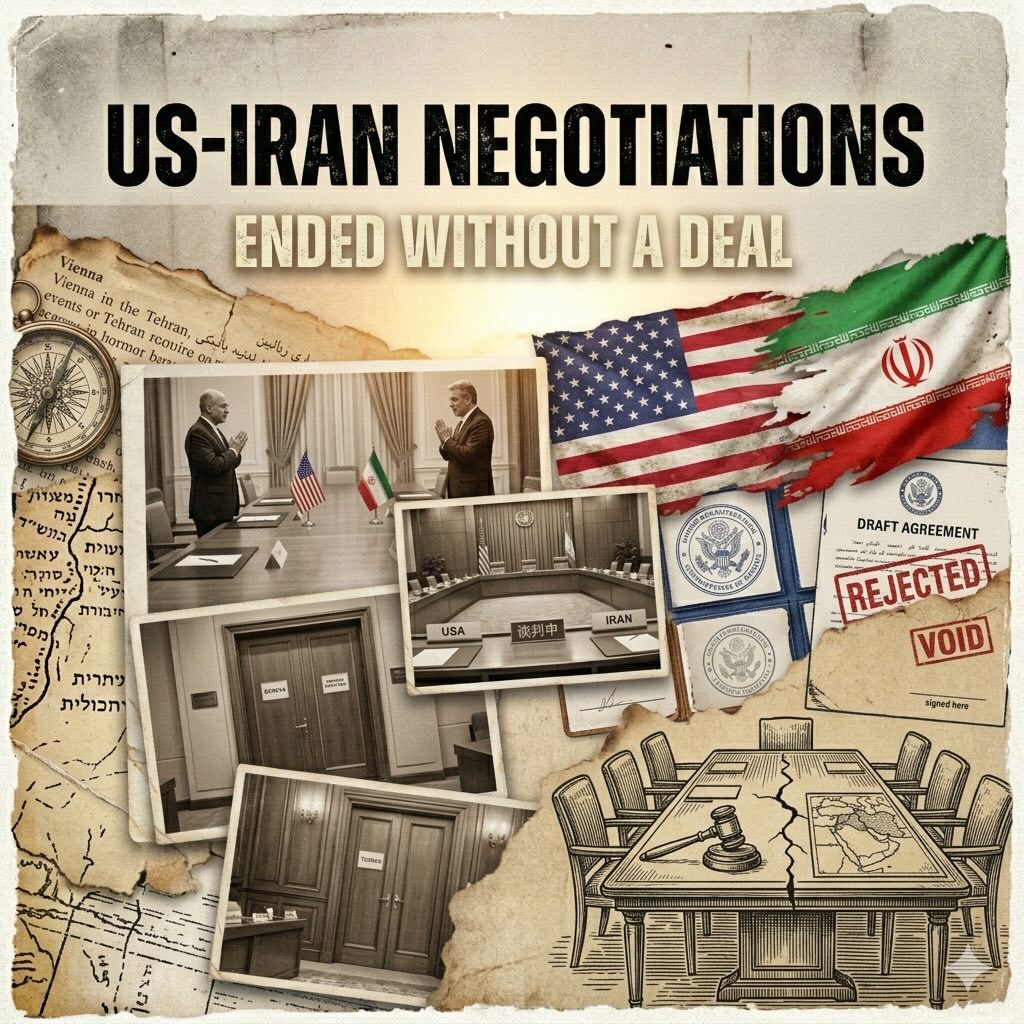
Pakistan brokered the highest-level direct engagement between Washington and Tehran since Iran’s 1979 revolution. Twenty-one hours of negotiations ended without a deal, but also without a collapse. Here is what took place and what it means.
Published: 13 April 2026 | Last Updated: 13 April 2026
Byline: Global War News Editorial
The Setting
Islamabad woke up on the morning of Saturday, 11 April to a city under lockdown. Roads were sealed, checkpoints appeared, and more than 10,000 security personnel were deployed in preparation for what would become the most significant diplomatic encounter between the United States and Iran in over four decades.
The talks, which lasted approximately 21 hours across 11 and 12 April 2026, marked the highest-level direct engagement between the two countries since the Iranian Revolution of 1979. They were hosted at Islamabad’s Serena Hotel, a property that was fully vacated of guests and converted into a controlled diplomatic environment for the occasion.
The 300-member US negotiating team was led by Vice President JD Vance, alongside special envoys Steve Witkoff and Jared Kushner. The 70-member Iranian team was led by parliamentary speaker Mohammad Bagher Ghalibaf and Foreign Minister Abbas Araghchi. Pakistan’s mediating team was led by Prime Minister Shehbaz Sharif, Field Marshal Asim Munir, and Deputy Prime Minister and Foreign Minister Ishaq Dar.
Background: How the Conflict Reached This Point
The talks followed a major escalation in hostilities beginning in February 2026, when coordinated strikes by the United States and its allies triggered a broader regional war involving Iran and multiple Middle Eastern actors. The conflict had been running for approximately six weeks before a temporary ceasefire created the window for these negotiations.
Among the most immediate consequences of that war: Iran had imposed a de facto blockade on the Strait of Hormuz, through which roughly one-fifth of global crude oil supplies pass. The closure caused a global energy crisis and rattled stock markets worldwide.
The ceasefire itself was fragile from the start. Israel killed more than 350 people in Lebanon on the day after the US-Iran ceasefire was announced, with a third of those killed reported to be women and children, according to Lebanon’s health ministry. Tehran maintained that Lebanon was included in the ceasefire. Washington and Tel Aviv both rejected that position.
Why Pakistan?
Pakistan’s role as host and mediator did not happen by accident. Pakistan has close ties with Gulf states including Saudi Arabia and Qatar, shares a long and sensitive border with Iran, and its ports sit close to the Strait of Hormuz. Its relationship with China adds another layer of strategic relevance. Unlike several other potential mediators in the region, it does not host US military bases.
By having good ties with both Tehran and Washington, and having played no direct part in the war, Pakistan was able to bring the two adversaries to the same table. That combination of factors, geographic, diplomatic, and strategic, was rare enough that few other capitals could credibly claim the same position.
What Happened Inside the Talks
Officials described the 21 hours of negotiations as “continuous, but uneven.” The first session lasted under two hours, followed by a pause that was partly procedural and partly cultural. What followed was more intense: multiple rounds, drafts exchanged, and positions restated throughout the night.
The talks consisted of three rounds. The first was indirect. The second and third were direct. The teams were reportedly able to find common ground on the main points of the ceasefire framework, with the exception of two core issues: the Strait of Hormuz and Iran’s nuclear programme.
Throughout the process, both delegations maintained active communication with their respective capitals. The American delegation was in repeated contact with Washington, including with President Donald Trump. Iranian negotiators were also reportedly relaying developments back to Tehran in real time.
Iran had entered the talks with stated preconditions. Tehran’s demands included an end to Israel’s attacks against Hezbollah in Lebanon, the release of approximately six billion dollars in frozen Iranian assets, guarantees around its nuclear programme, and the right to charge ships passing through the Strait of Hormuz.
The US position was framed differently. Washington wanted a clear and enforceable commitment that Iran would not develop nuclear weapons, or even acquire the capability to do so quickly, with sanctions relief offered as a conditional incentive.
Why It Fell Apart
By the final stretch of the talks, the two sides had not bridged their core differences.
US Vice President Vance, who led the American delegation, said Iran had “chosen not to accept our terms” and that Washington needed a “fundamental commitment” from Tehran not to develop nuclear weapons.
Vance described the US position as its “final and best offer,” leaving open the possibility that an agreement could still be reached if Iran accepted it.
Iran’s interpretation of the outcome was different. Foreign Minister Abbas Araghchi claimed Iran was “inches away from a Memorandum of Understanding” and accused the US delegation of moving the goalposts and maximising its demands at the final stage.
Iranian Parliament Speaker Ghalibaf, the head of Tehran’s delegation, said the US had ultimately failed to gain the trust of the Iranian side, stating: “The US has understood Iran’s logic and principles, and it’s time for them to decide whether they can earn our trust or not.”
The nuclear question was the central point of failure. Al Jazeera’s correspondent in Islamabad noted that while Iran had not proposed a complete surrender of its nuclear ambitions in the framework it brought to the table, what Washington was now effectively demanding was that Tehran give up its right to any nuclear programme, including for medical purposes.
The Strait of Hormuz was equally contested. Iran’s semi-official Fars News Agency quoted an Iranian official as saying the US had made “excessive demands,” arguing that Washington appeared to be seeking through negotiations what it had failed to achieve through military pressure. Reports indicated the US had floated the idea of joint US-Iranian administration of the Strait. Tehran rejected this, saying the waterway falls within the territorial waters of Iran and Oman, and those two countries should control it.
Analysis
The following section represents the editorial interpretation of Global War News based on reported facts. It does not constitute advocacy for any party.
The Islamabad talks produced no agreement. They also produced no rupture. In a conflict defined by deep mistrust, that distinction matters.
Both delegations entered with structural constraints that made a single-session deal nearly impossible. Tehran arrived carrying political pressure from hardliners at home and a specific grievance: Iran had been bombed twice during active negotiations over the past year. As analysts noted, the Iranian side was not simply asking for concessions. It was asking for evidence that any concessions it made would not be followed by renewed military pressure. That is not a demand that a 21-hour meeting can satisfy.
Washington, for its part, was negotiating in a context where its key ally, Israel, had publicly rejected the ceasefire’s application to Lebanon and was continuing military operations there. Israeli Prime Minister Benjamin Netanyahu stated during the Islamabad talks that “Israel under my leadership will continue to fight Iran’s terror regime and its proxies.” That made Iranian assurances to any US delegation inherently harder to anchor to a stable political reality.
The immediate risk is what happens next to the ceasefire itself. After the talks ended, President Trump announced a naval blockade of the Strait of Hormuz to stop Iranian use of the waterway. Iran’s Revolutionary Guards responded with a warning that “any miscalculated move will trap the enemy in the deadly whirlpools in the Strait.” That exchange, coming hours after the delegations departed Islamabad, is the clearest signal of where the pressure points lie.
Pakistan’s position, meanwhile, is one to watch. Foreign Minister Ishaq Dar urged both sides to maintain the ceasefire and stated that Pakistan would continue to facilitate engagement in the days ahead. Whether Islamabad can hold that role as tensions over the Strait escalate is an open question.
The door is not closed. But the path through it is narrower now than it was before the talks began.
What to Watch Next
Three things will determine whether this process continues or collapses: whether the ceasefire between the US and Iran holds in practice while Israel’s operations in Lebanon continue; whether Trump’s announced naval blockade in the Strait escalates into a direct confrontation with Iranian forces; and whether Pakistan and the other regional intermediaries, including China and Qatar, can keep backchannel communications alive until a second round of talks becomes politically viable.
Iran’s Foreign Ministry spokesperson Esmaeil Baghaei stated that “no one had expected to reach an agreement in a single session,” and that Tehran was “confident that contacts between us and Pakistan as well as our other friends in the region will continue.”
That framing leaves space. Whether either side uses it is another matter.
Sources used in this article: Al Jazeera (Osama Bin Javaid, reporting from Islamabad, 13 April 2026; Al Jazeera News, 12 April 2026); NPR (12 April 2026); Time Magazine (13 April 2026; 11 April 2026); Wikipedia: Islamabad Talks (last updated 13 April 2026); Iran’s state broadcaster IRIB, as cited by Al Jazeera; US Vice President JD Vance, public press conference remarks, Islamabad, 12 April 2026; Iranian Parliament Speaker Mohammad Bagher Ghalibaf, post on X, 12 April 2026; Iranian Foreign Minister Abbas Araghchi, cited by Al Jazeera; Pakistani Foreign Minister Ishaq Dar, public statement, Islamabad, 12 April 2026; Israeli Prime Minister Benjamin Netanyahu, post on X, cited by Al Jazeera; Iran’s Revolutionary Guards, public statement cited by Time; Human Rights Activists News Agency, civilian casualty figures as cited by Time.
This article is based on publicly available reporting from named international news agencies and attributed official statements. All claims about ongoing events are attributed to their original sources. Analysis sections represent the editorial interpretation of reported facts and do not constitute advocacy for any party to the described conflict. This publication does not take political positions on active military conflicts.