


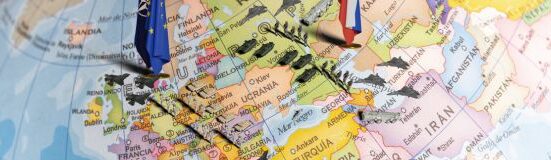


Zelensky Ready to Step Down If It Secures Ukraine’s NATO Membership Amid Trump Criticism
On the eve of the third anniversary of Russia’s invasion, Ukrainian President Volodymyr Zelensky declared he would be willing to resign if it meant Ukraine could gain NATO membership.
His statement comes amid mounting tensions with the new US administration. Former President Donald Trump, in a series of verbal attacks, labeled Zelensky a “dictator” for postponing elections—though Ukrainian law permits this during wartime. Trump also falsely accused Ukraine of starting the war and claimed, contrary to independent polls, that Zelensky was unpopular at home.
“If there is peace for Ukraine, if you really need me to leave my post, I am ready… I can exchange it for NATO,” Zelensky said in a Kyiv press conference, adding that he would resign “immediately” if necessary.
US-Ukraine Tensions Over Security and Resources
Zelensky has been advocating for NATO membership as part of any peace deal to end the war, but the alliance has remained hesitant. His remarks follow reports that US and Russian officials recently held high-level talks in Saudi Arabia, their first such meeting in three years. The development angered Ukraine and its European allies, as they were excluded from the discussions.
Despite Trump’s criticism, Zelensky dismissed being “offended” and reiterated his willingness to run in elections once martial law is lifted. “One would be offended by the word ‘dictator’ if he was a dictator,” he remarked.
The Ukrainian president also urged Trump to meet with him before any summit with Russian President Vladimir Putin. He revealed that progress was being made on a deal that would grant the US preferential access to Ukraine’s rare earth minerals—a strategic resource essential for modern technology.
“If your conditions are, ‘We will not give you aid if you do not sign an agreement,’ then it is clear,” Zelensky said. “If we are forced and we cannot do without it, then we should probably go for it… I just want a dialogue with President Trump.”
Zelensky previously rejected a $500 billion proposal from the US, arguing that it would burden Ukrainian generations for decades. His chief of staff, Andrii Yermak, and Economic Minister Yuliia Svyrydenko left a Kyiv forum early on Sunday for talks with US officials regarding a potential deal.
Kremlin Welcomes US-Russia Dialogue
Meanwhile, Moscow welcomed signs of renewed US-Russia dialogue. Kremlin spokesperson Dmitry Peskov praised the potential talks between Trump and Putin as “promising,” calling them a step forward for international diplomacy.
However, Peskov dismissed any notion of Ukraine joining NATO and reiterated that Russia would never cede occupied Ukrainian territories, citing staged referendums in eastern Ukraine that have been widely condemned as fraudulent.
“The people decided to join Russia a long time ago,” Peskov stated. “No one will ever sell off these territories. That’s the most important thing.”
Putin: ‘Fate’ and ‘God’ Behind the War
As the war enters its third year, Russian President Vladimir Putin defended his actions, claiming “fate” and “God” had placed the mission of defending Russia on his shoulders. Speaking to Russian servicemen, Putin commended their efforts, calling them defenders of “national interests and Russia’s future.”
Russia continues its military offensive, launching a record 267 drone attacks on Ukraine overnight. Ukraine’s air force reported that nearly all were intercepted, with no major damage recorded.
Europe Prepares for High-Level Talks
As tensions rise, European leaders are preparing for diplomatic discussions with Ukraine. European Commission President Ursula von der Leyen and top EU officials are set to visit Kyiv on Monday.
Meanwhile, UK Prime Minister Keir Starmer and French President Emmanuel Macron will travel to Washington this week to push back against any potential US disengagement from Ukraine. Britain is also set to announce a new round of sanctions against Russia—the most significant package since the early days of the war.
“There can be no discussion about Ukraine without Ukraine,” Starmer emphasized. “The people of Ukraine must have a long-term secure future.”