
Kyiv targets “Technological Parity” as intelligence reports suggest a massive Russian buildup along the Kharkiv-Luhansk axis.
Published: April 14, 2026 Last Updated: 17:35 GMT
By Global War News Editorial
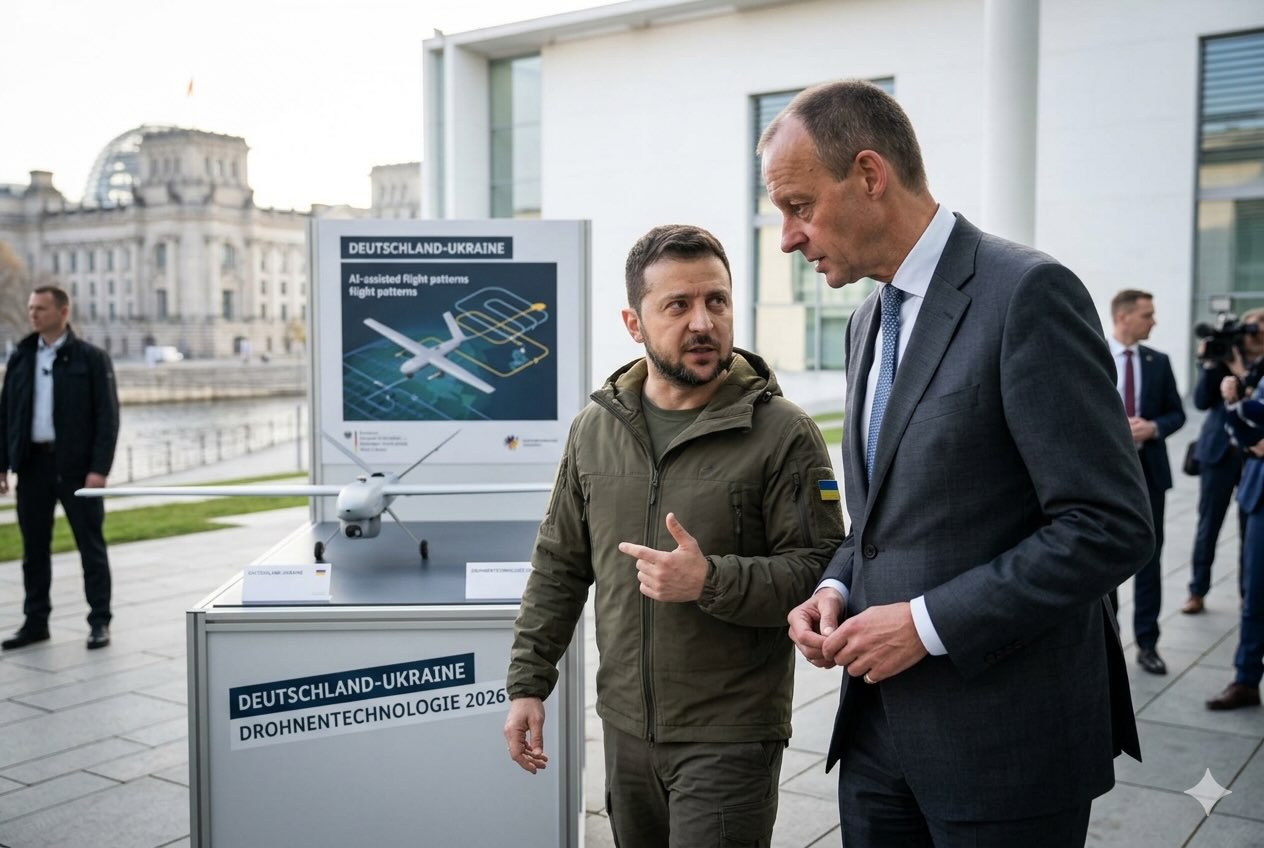
Ukrainian President Volodymyr Zelenskyy arrived in Berlin on Tuesday for an unannounced summit with German Chancellor Friedrich Merz. The high-stakes meeting centers on a specific request for advanced drone technology and electronic warfare (EW) systems, which Kyiv insists are vital to blunting a projected Russian spring offensive.
Standing alongside Chancellor Merz at the Chancellery, Zelenskyy emphasized that the nature of the conflict has shifted toward a “war of sensors and precision.” According to a statement from the Ukrainian Presidency, the primary objective of the visit is to secure a commitment for the joint production of long-range reconnaissance and “kamikaze” drones, as well as the German-made “Skyranger” mobile air defense systems.
Bracing for the Spring Offensive
The meeting comes amid sobering intelligence assessments from NATO and Ukrainian military command. Reports from the Institute for the Study of War (ISW) suggest that Russia has massed approximately 150,000 fresh troops and hundreds of refurbished tanks along the northeastern front.
“The enemy is adapting,” Zelenskyy stated during a brief press conference. “They are using massed drone strikes to overwhelm our defenses. We do not just need more ammunition; we need the technological edge to blind their eyes and drop their drones from the sky.” Chancellor Merz, while stopping short of announcing a specific new shipment, reaffirmed Germany’s “unwavering support” and noted that Berlin is reviewing how to accelerate the delivery of high-tech defense components.
The Drone Gap
Military observers note that both sides are currently locked in an industrial race to produce cheap, effective FPV (First-Person View) drones and more sophisticated loitering munitions.
- German Integration: Kyiv is particularly interested in German AI-assisted target acquisition software, which could allow drones to operate even in environments where Russian electronic jamming has cut off manual pilot control.
- Domestic Production: A key part of the Berlin talks involves “localization”—building German-designed drone components within protected underground facilities in Ukraine to bypass long logistics chains.
- Industrial Strain: According to a report by Reuters, German defense contractors have warned that while they can increase production, they face shortages of specialized semiconductors, a point Chancellor Merz promised to address at the upcoming EU industrial summit.
Analysis: Berlin’s Shifting Defense Policy
Observers note that under Chancellor Merz, Germany has adopted a more assertive stance regarding military aid compared to previous administrations. The focus has moved from “defensive shielding” to providing the tools for “active deterrence.”
However, this shift faces domestic political headwinds. While the Merz administration maintains a parliamentary majority for aid packages, recent polling by public broadcaster ARD suggests that approximately 40% of the German public remains concerned about the risk of direct escalation with Moscow. Analysts suggest that by focusing on “drone technology” rather than heavy tanks or long-range missiles, the Chancellery may be attempting to frame the aid as a modern, precision-based necessity that minimizes the footprint of traditional warfare.
What to Watch
The outcome of these talks will likely be reflected in the next “Ramstein-format” meeting of Ukraine’s supporters. If Germany commits to a massive transfer of EW and drone tech, it could signal a new phase of European military involvement where “tech-sharing” becomes as significant as hardware transfers. Meanwhile, the clock is ticking; Ukrainian military intelligence expects the Russian offensive to begin in earnest before the end of May.
Sources: Deutsche Welle (DW), Reuters, Associated Press, Institute for the Study of War (ISW), Official Portal of the President of Ukraine, ARD News.
This article is based on publicly available reporting from named international news agencies and attributed official statements. All claims about ongoing events are attributed to their original sources. Analysis sections represent the editorial interpretation of reported facts and do not constitute advocacy for any party to the described conflict. AI tools may be utilized for image generation to assist in explaining complex concepts, as well as for refining grammar, spelling, and other linguistic enhancements. However, all original content is produced, fact-checked, and revised by the editorial team. This publication does not take political positions on active military conflicts.