Russia claims its air defences intercepted 1,198 Ukrainian drones overnight, while fresh attacks on both sides coincided with renewed diplomatic efforts involving the United States and Europe.
By GlobalWarNews Desk
13 November 2026 | International | Ukraine–Russia War
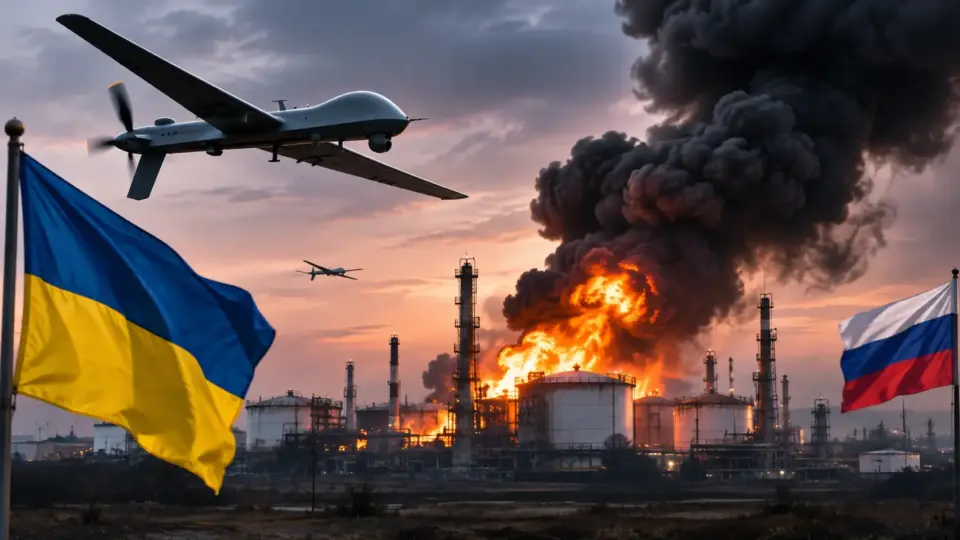
Ukraine drone strikes targeted several Russian regions overnight on November 13, including a reported strike on the Volgograd oil refinery, as Moscow said its air defence systems intercepted 1,198 drones. The interception figure is a Russian government claim and has not been independently verified.
The reported operation comes amid continued attacks between Moscow and Kyiv, while diplomatic efforts involving the United States and European representatives are entering another important phase.
Russia’s Ministry of Defence said its air defence systems intercepted and destroyed 1,198 Ukrainian long-range drones between Thursday night and Friday morning. The claim, which has not been independently verified, came as Russian regional authorities reported civilian deaths and damage in several areas.
In one of the most significant reported incidents, Ukraine’s General Staff said Ukrainian forces struck an oil refinery in Volgograd, causing a fire at the facility.
The attack came at a particularly sensitive moment in the conflict. American officials have been engaged in diplomatic discussions with both Moscow and Kyiv, with the possibility of bringing European countries into future negotiations now emerging as a major development.
The simultaneous military escalation and diplomatic activity raise questions about whether either side is preparing to compromise or attempting to strengthen its position before negotiations advance.
Russian regions report casualties following overnight attacks
According to Russia’s Defence Ministry, air defence units intercepted 1,198 Ukrainian drones during the overnight operation. The ministry’s announcement covered multiple Russian regions, including areas far from the Ukrainian border.
Russian regional authorities reported that attacks across three regions killed seven people, including a 12-year-old child, while another 17 people were injured, according to reporting by The Associated Press.
Volgograd was among the affected areas. Regional officials reported casualties in the city’s southern industrial zone, where the oil refinery targeted by Ukrainian forces is located.
Ukraine’s General Staff confirmed the strike against the refinery and said the facility caught fire.
Oil refineries are strategically important to Russia because they process crude oil into fuels and other petroleum products used by civilian industries and the military. Damage to these facilities can create operational difficulties, particularly when repairs require specialised equipment and replacement components.
However, the full extent of the damage to the Volgograd refinery, the duration of any production disruption and its wider impact on Russian fuel supplies have not yet been independently established.
The number of drones cited by Moscow also requires careful interpretation. The 1,198 figure represents Russia’s claimed interceptions, not an independently confirmed count of drones launched by Ukraine. The actual number deployed and the proportion that reached their intended targets remain unclear.
Russia continues drone attacks across Ukraine
While Ukraine conducted its operation inside Russian territory, Russian forces also launched another large-scale drone attack against Ukraine overnight on November 12–13.
Ukraine’s Air Force reported that Russia deployed 117 strike drones, including Shahed-type attack drones, jet-powered variants and decoy drones.
Ukrainian air defence forces reported intercepting or suppressing 80 of the incoming drones. However, strikes were recorded at 24 locations, with debris from intercepted drones reported at another 10 locations.
The attacks were accompanied by further reports of civilian casualties and damage to residential and medical infrastructure.
A Russian strike on apartment buildings in the southern Ukrainian city of Zaporizhzhia wounded 30 people, including six children, according to local officials cited by The Associated Press.
A medical facility in Kyiv was also damaged during the overnight attacks.
The latest strikes come as Ukraine faces growing pressure on its electricity infrastructure. Ukrainian energy officials reported widespread power outages across approximately half of the country’s regions following Russian attacks on energy facilities.
With another winter approaching, attacks on electricity generation and distribution networks remain a serious concern for Ukrainian authorities. Damage to power infrastructure can affect homes, hospitals, industrial production and essential public services.
The developments demonstrate that neither side has suspended its military campaign while diplomatic discussions continue.
European involvement emerges as a major issue in peace negotiations
Alongside the overnight attacks, diplomatic discussions surrounding the war have entered another potentially significant phase.
US special envoys Steve Witkoff and Jared Kushner have been conducting discussions with Russian and Ukrainian representatives. Following meetings with Russian President Vladimir Putin in Moscow, the American officials travelled to Dublin, where they met Ukrainian President Volodymyr Zelenskyy.
The discussions followed two days of negotiations involving Russian, Ukrainian and American delegations in Abu Dhabi.
One of the main developments announced by the American and Ukrainian representatives was the possibility of including European countries in future negotiations.
Kushner said in a post on X that both sides had agreed to expand the next round of discussions to include European partners.
He indicated that the broader negotiations could address European security arrangements alongside the territorial issues between Russia and Ukraine.
Zelenskyy welcomed European participation, arguing that European governments should have a direct role in discussions concerning the continent’s future security.
However, the announcement should not be interpreted as a confirmed agreement by Moscow.
As reported by Euronews on Friday, Russia had not formally confirmed whether it had agreed to include European negotiators in subsequent discussions. Russian presidential aide Yuri Ushakov reiterated Moscow’s reservations about European involvement.
The disagreement highlights one of the central difficulties facing the diplomatic process: the parties do not necessarily share the same understanding of who should participate or what issues should be negotiated.
Why Europe’s involvement matters
European participation is particularly important because the outcome of the war will have consequences beyond the borders of Russia and Ukraine.
The conflict has fundamentally changed European defence planning, increased concerns about regional security and placed NATO’s long-term strategic position at the centre of international discussions.
European leaders have expressed concern that negotiations involving Washington and Moscow could determine important security arrangements without giving European governments sufficient influence.
EU foreign policy chief Kaja Kallas has argued that a ceasefire should come before broader discussions about European security architecture.
Her position reflects a wider concern among European leaders that discussing the continent’s future security arrangements without first addressing Russia’s military campaign could weaken Europe’s negotiating position.
Germany’s Chancellor Friedrich Merz has also rejected the idea that Europe’s existing security framework needs to be renegotiated under Russian pressure, pointing to NATO’s role in the continent’s defence.
For Ukraine, European participation could be important in securing long-term guarantees against another Russian invasion.
For Russia, discussions about European security provide an opportunity to raise longstanding demands concerning NATO and the post-Cold War security order.
Consequently, the negotiations are becoming about more than the future borders of Ukraine. They increasingly involve the wider balance of power between Russia, Europe and the United States.
Analysis: Military escalation may be shaping the negotiating position
The latest developments illustrate a familiar pattern in the conflict: military operations continue even when diplomatic channels become more active.
Ukraine’s ability to conduct long-range drone operations against Russian territory demonstrates its continued effort to impose costs on Russian military and economic infrastructure beyond the immediate battlefield.
Attacks targeting oil refineries and other industrial facilities can place additional pressure on Russia’s economy and complicate the country’s ability to sustain its war effort.
However, the strategic value of such operations should not be measured simply by the number of drones reported. What matters is the damage inflicted, the economic impact, the resources required to repair affected facilities and the ability of Russian air defences to respond to repeated attacks.
Russia, meanwhile, continues to use large-scale drone attacks against Ukrainian cities and infrastructure. The pressure on electricity networks and civilian facilities illustrates how the conflict continues to affect Ukraine’s ability to maintain normal economic and social activity.
The diplomatic situation presents a separate challenge.
Although Washington’s efforts to bring the parties closer together have created opportunities for further discussions, there is little evidence that the fundamental disagreements have been resolved.
Territorial control, Ukraine’s future security arrangements, NATO’s position in Europe and the possibility of foreign peacekeeping forces remain major obstacles.
Putin has indicated that Russia will not abandon its territorial demands and has rejected the proposed deployment of foreign peacekeeping troops in Ukraine, according to reporting on the recent discussions.
These positions suggest that a comprehensive settlement remains difficult to achieve.
There is also a risk that expanding the negotiating agenda to include the entire European security framework could make an already difficult process more complicated.
European involvement may be essential to securing a lasting agreement. Nevertheless, bringing additional governments and strategic interests into the discussions could increase the number of issues that must be resolved before a deal becomes possible.
For now, military pressure appears to be continuing alongside diplomatic engagement rather than giving way to it.
What happens next?
The immediate questions are whether Ukraine can sustain its long-range drone campaign, how effectively Russia can defend its critical infrastructure and whether the latest diplomatic discussions can produce a clearly defined negotiating framework.
The involvement of European representatives could become an important development if Moscow formally accepts their participation.
However, there are still no confirmed indications of an imminent ceasefire.
Both countries continue to conduct military operations, civilian infrastructure remains under threat and disagreements over the conditions for ending the war remain substantial.
The latest developments therefore represent two parallel realities of the conflict: an increasingly extensive campaign of long-range attacks and an international diplomatic effort that has yet to overcome the fundamental differences between the parties.
For Ukraine, Russia and the wider European security system, the next round of negotiations could prove important. Whether it leads to a meaningful reduction in fighting remains uncertain.
GlobalWarNews Analysis: The battlefield is expanding the pressure on both countries, but the negotiating table has yet to produce the compromises required to end the war.