
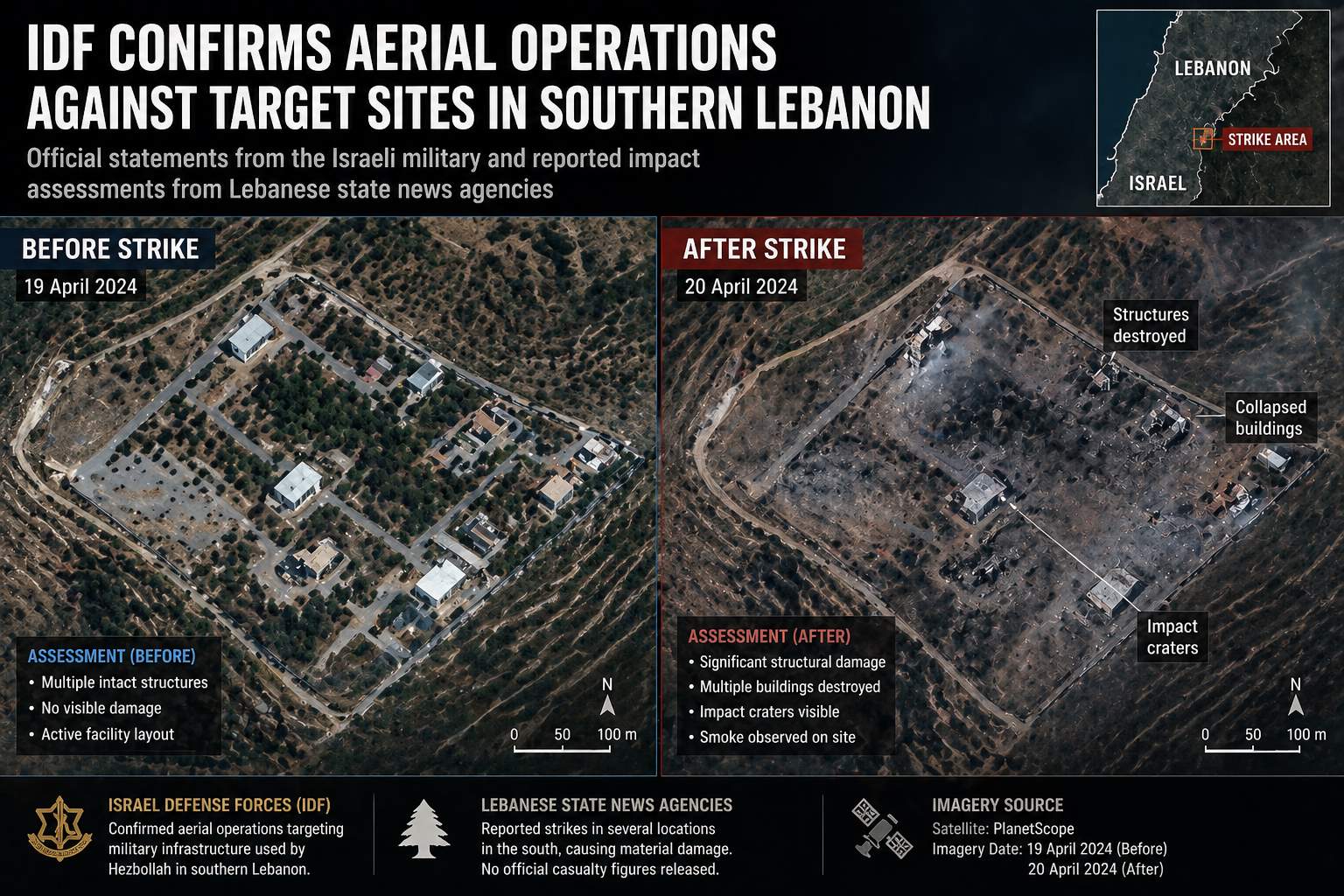
Israeli military cites “preventative measures” while Lebanese state media reports significant damage to civilian infrastructure in the border regions.
April 28, 2026
Last Updated: April 28, 2026
By Global War News Editorial
The Israel Defense Forces (IDF) have confirmed a series of coordinated aerial operations against multiple sites in Southern Lebanon throughout the early hours of Tuesday. According to an official statement released via the IDF’s digital channels, the strikes targeted what were described as “military infrastructure and launch posts” belonging to armed groups in the region.
Simultaneously, the Lebanese National News Agency (NNA) has reported that the strikes impacted several villages in the Tyre and Nabatieh districts. While the Israeli military maintains that the operations were surgical in nature, Lebanese officials have pointed to significant damage to non-military structures, including agricultural warehouses and local power lines.
The escalation comes after a period of relative quiet along the “Blue Line,” the UN-recognized border between the two nations. However, regional observers note that the frequency of cross-border engagements has increased over the last 72 hours, raising concerns about the stability of the current security protocols.
Official Israeli Military Objectives
In a briefing held in Tel Aviv, an IDF spokesperson stated that the aerial campaign was launched in response to “imminent threats” detected by intelligence surveillance. The military claimed that the targeted sites were being utilized to store advanced weaponry and as staging grounds for potential incursions.
“Our operations are focused on neutralizing capabilities that threaten the safety of northern Israeli communities,” the spokesperson said. According to the IDF, at least six distinct locations were hit, including what they identified as an underground storage facility. The Israeli military has not released specific casualty figures but noted that “precision-guided munitions” were used to minimize collateral effects.
Lebanese State Reports and Civilian Impact
The Lebanese National News Agency (NNA) provided a different assessment of the morning’s events. According to NNA reports, Israeli fighter jets conducted “mock raids” followed by actual strikes near the outskirts of the town of Khiam and the village of Kfar Kila.
The Lebanese Ministry of Public Health, in a preliminary report, stated that three civilians were treated for smoke inhalation and minor injuries following a strike on a commercial depot. Furthermore, the Lebanese state utility provider reported that a primary transformer in the Marjayoun district was damaged, leading to localized power outages for approximately 15,000 residents.
Local governors in Southern Lebanon have called for an immediate session with UNIFIL (United Nations Interim Force in Lebanon) to document the damage and assess the breach of international law.
Analysis: The Strategic Calculus of “Gray Zone” Conflict
Military analysts suggest that these latest strikes represent a shift in the IDF’s “active defense” doctrine. By striking targets deep within Southern Lebanon, the Israeli command appears to be attempting to establish a buffer zone of deterrence.
However, observers note that this strategy carries high risks. Analysis from international monitors suggests that:
- Intelligence Gaps: There is a persistent discrepancy between what the IDF identifies as “military targets” and what local Lebanese authorities report as “civilian infrastructure.”
- Escalation Ladder: Each strike increases the domestic political pressure on the Lebanese government and regional armed groups to retaliate, potentially leading to a cycle that UNIFIL may be unable to contain.
- Economic Strain: For Lebanon, which is already grappling with a severe financial crisis, the destruction of power and agricultural assets in the south further complicates any path toward national economic recovery.
The central question remains whether these operations will achieve long-term quiet or if they serve as a prelude to a more extensive ground engagement.
Closing Summary
As of Tuesday afternoon, a tense calm has returned to the border region, though Israeli reconnaissance drones remain visible over Southern Lebanese airspace. UNIFIL has urged both parties to exercise maximum restraint to prevent a wider conflagration. We will continue to monitor official statements from both Beirut and Tel Aviv as the situation evolves.
Sources: This report is based on official statements from the Israel Defense Forces (IDF), reporting from the Lebanese National News Agency (NNA), and briefings from the Lebanese Ministry of Public Health. Additional context provided by UNIFIL press releases.
This article is based on publicly available reporting from named international news agencies and attributed official statements. All claims about ongoing events are attributed to their original sources. Analysis sections represent the editorial interpretation of reported facts and do not constitute advocacy for any party to the described conflict. AI tools may be utilized for image generation to assist in explaining complex concepts, as well as for refining grammar, spelling, and other linguistic enhancements. However, all original content is produced, fact-checked, and revised by the editorial team. This publication does not take political positions on active military conflicts.