
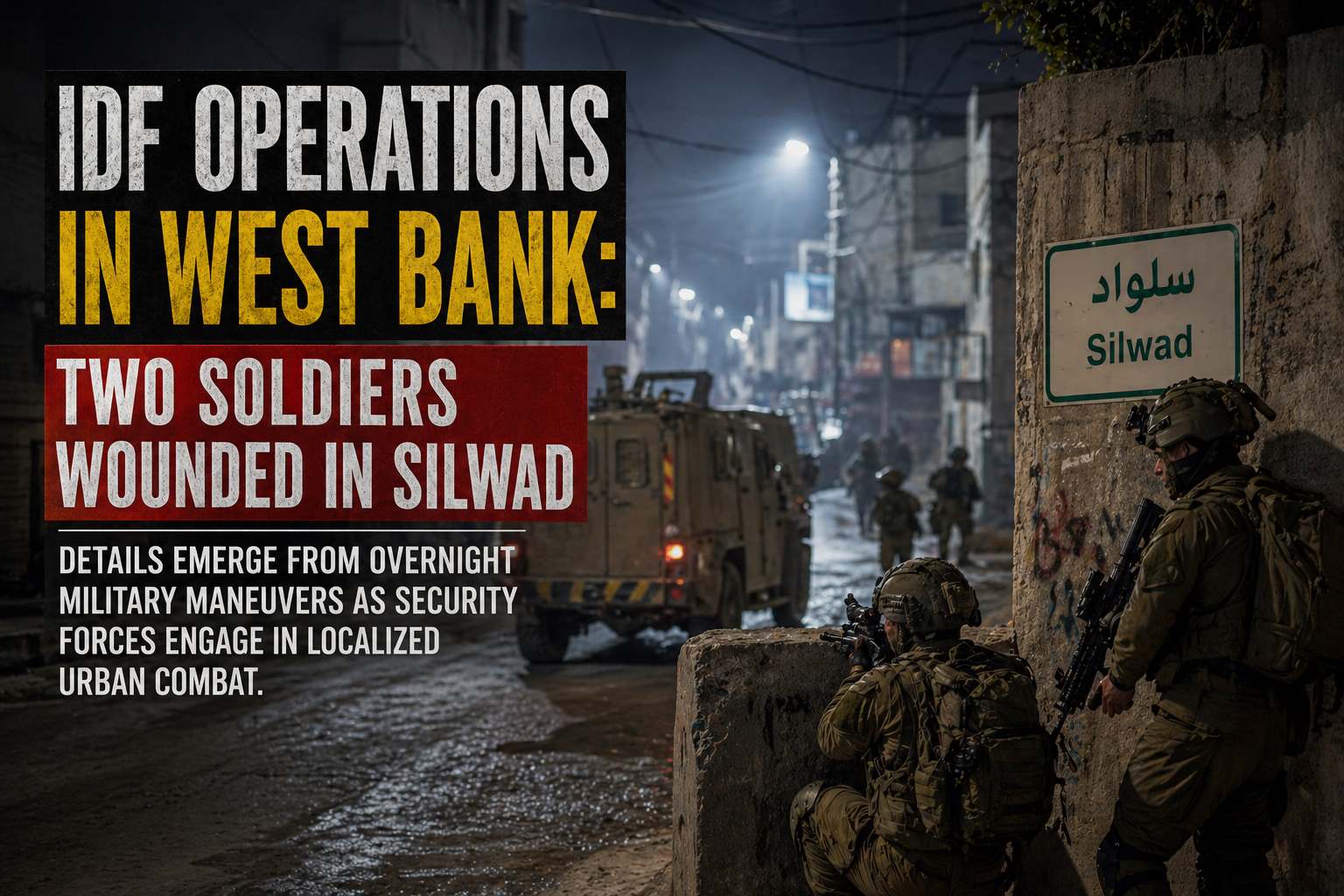
Security operations and localized urban combat disrupt regional transport and trade hubs as military presence intensifies.
April 30, 2026
By Staff Writer, Global War News
Security operations in the West Bank town of Silwad, located northeast of Ramallah, resulted in the wounding of two Israeli soldiers during overnight maneuvers. According to a statement from the Israel Defense Forces (IDF), the soldiers sustained injuries when an explosive device was detonated near their vehicle during an operational activity aimed at detaining suspects.
The military reported that one soldier is in moderate condition while the other sustained minor injuries. Both were evacuated to a hospital for medical treatment. The IDF stated that its forces returned fire toward the source of the blast and continued with searches in the area. Local Palestinian media outlets reported that the military presence in Silwad led to localized urban combat, with residents describing heavy gunfire and the deployment of additional armored units throughout the night.
These developments come amid a broader increase in military activity across the West Bank. The Palestinian health authorities have not yet confirmed specific casualty figures for residents in Silwad following this specific incident, though they noted that several individuals were detained during the raid.
Context and Background
Silwad has historically been a flashpoint for friction due to its proximity to Route 60, a major North-South artery used by both Israeli settlers and Palestinian commuters. Security operations in this sector are frequently linked to efforts to prevent roadside attacks on this highway.
Over the past year, the frequency of “brigade-level” operations has transitioned into more frequent, smaller-scale raids. These actions often focus on the infrastructure of local armed groups. The use of improvised explosive devices (IEDs) against armored patrols has become a recurring tactical feature of these encounters, reflecting an evolution in local resistance methods.
Economic Impact
The immediate economic consequence of the Silwad operation was the temporary closure of access points to Route 60. According to local logistical reports, the disruption stalled the movement of agricultural goods and laborers for several hours. Analysts note that frequent, unpredictable closures in the Ramallah governorate create a “friction tax” on the Palestinian economy, increasing transport costs and reducing the reliability of supply chains.
The World Bank has previously stated that movement and access restrictions remain a primary barrier to Palestinian economic growth. When military operations enter urban centers like Silwad, local markets typically shutter, leading to a total cessation of retail activity for the duration of the engagement.
Analysis: What This Could Mean
The targeting of Israeli military vehicles with explosives suggests a continued high level of coordination among local armed factions. For the IDF, the wounding of personnel in what was intended to be a routine detention raid may lead to more aggressive “clearance” operations in the coming days.
From a regional perspective, the persistence of these clashes complicates diplomatic efforts to stabilize the West Bank. Observers note that while international attention is often fixed on larger-scale conflicts, these localized escalations are what fundamentally shape the daily economic reality and security perceptions for both populations on the ground. It remains unclear whether the current level of intensity will trigger a larger military response or if operations will remain limited to targeted raids.
Closing
The situation in Silwad remains tense as military units maintain a presence on the outskirts of the town. Security analysts will be watching closely to see if this incident leads to an extended closure of Route 60 or further raids in the Ramallah district.
Source Disclosure Note: Reporting based on official statements from the Israel Defense Forces (IDF), Palestinian Ministry of Health bulletins, and localized reporting from Reuters and Al Jazeera.
This article is based on publicly available reporting from named international news agencies and attributed official statements. All claims about ongoing events are attributed to their original sources. Analysis sections represent the editorial interpretation of reported facts and do not constitute advocacy for any party to the described conflict. AI tools may be utilized for image generation to assist in explaining complex concepts, as well as for refining grammar, spelling, and other linguistic enhancements. However, all original content is produced, fact-checked, and revised by the editorial team. This publication does not take political positions on active military conflicts.