
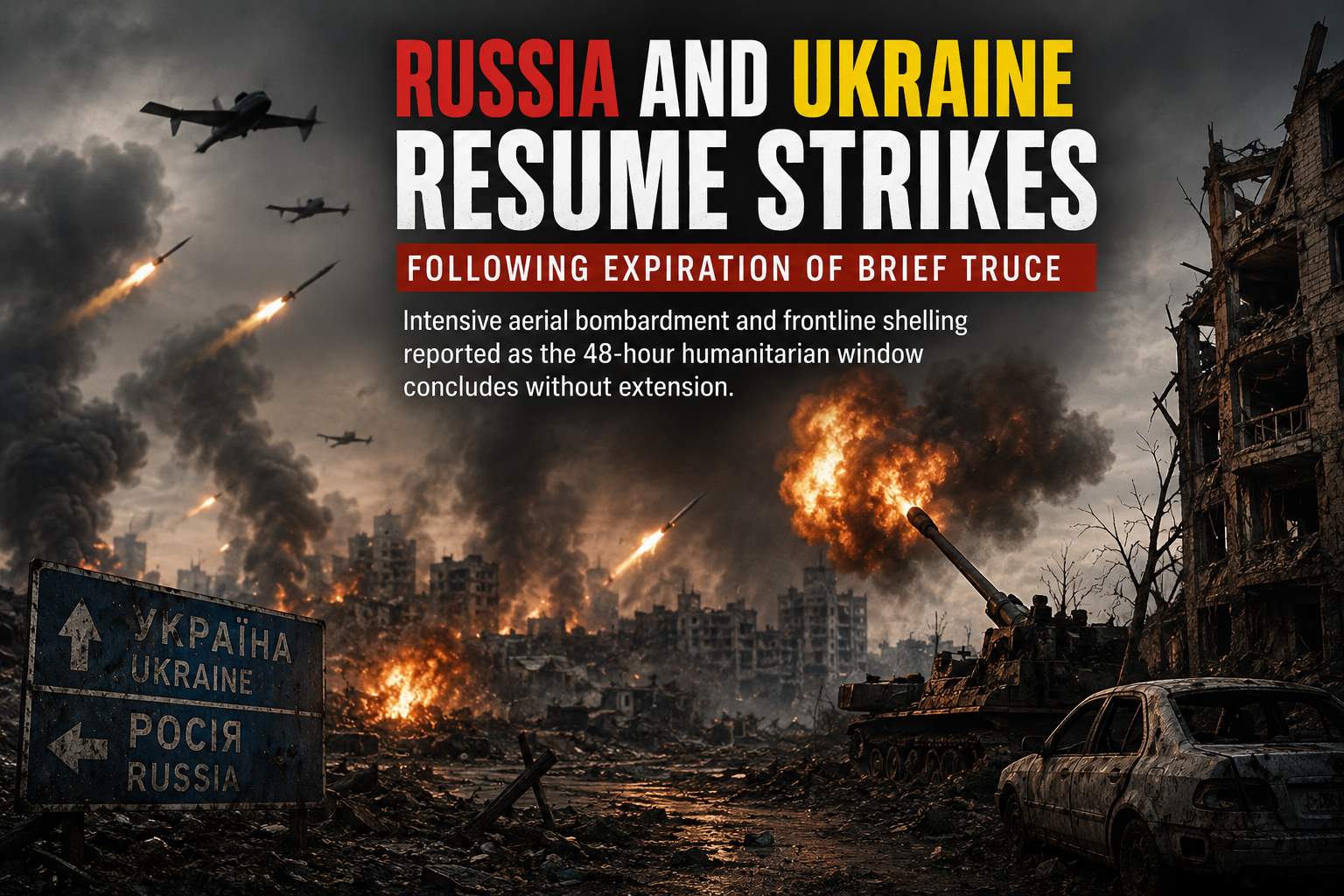
Intensive aerial bombardment and frontline shelling reported as the 48-hour humanitarian window concludes without extension.
May 12, 2026
Global War News Editorial
Military operations between Russian and Ukrainian forces have intensified following the expiration of a 48-hour temporary truce. According to reporting from Agence France-Presse (AFP), both nations launched a series of coordinated strikes targeting logistics hubs and energy infrastructure within minutes of the ceasefire’s official end at midnight.
The brief cessation of hostilities, which was mediated to allow for the evacuation of civilians from contested frontline sectors, concluded without an agreement for an extension. International observers had hoped the window might serve as a foundation for broader negotiations, but official statements from both Moscow and Kyiv suggest that the strategic objectives of both militaries remain unchanged.
Resumption of Aerial Campaigns
Immediately following the expiration of the truce, air raid sirens were activated across several Ukrainian oblasts. AFP reported that Ukrainian air defense systems were engaged in repelling drone and missile salvos directed at the Kharkiv and Dnipro regions. Ukrainian officials stated that these strikes targeted civilian infrastructure, though Russian military briefings claimed the operations were precision strikes aimed at disrupting Western-supplied hardware shipments.
Simultaneously, Russian authorities reported a series of long-range drone attacks targeting refinery facilities in the Belgorod and Rostov regions. According to local governors in the affected Russian border zones, emergency services were deployed to contain fires at two industrial sites. While the scale of the damage remains under assessment, these strikes indicate a return to the “war of attrition” strategy that characterized the weeks leading up to the pause.
Frontline Tactical Shifts
On the ground, the situation has returned to high-intensity shelling along the Donbas salient. Military analysts cited by regional news outlets suggest that both sides utilized the 48-hour window to reposition units and replenish ammunition stockpiles.
Reports from the frontline indicate that infantry engagements have resumed in the vicinity of Bakhmut and Avdiivka. While the brief truce allowed for the recovery of remains and a limited number of civilian exits, humanitarian organizations have expressed concern that the immediate resumption of heavy weaponry use has trapped remaining non-combatants in high-risk zones.
Analysis: The Limits of Humanitarian Windows
The rapid transition from a ceasefire to full-scale bombardment highlights the fragility of temporary agreements in the current phase of the conflict. Analysts note that without a political framework or a mutual willingness to make territorial concessions, these windows serve as tactical resets rather than diplomatic breakthroughs.
The expiration of this truce suggests that both commands currently prioritize military positioning over the potential for a sustained de-escalation. For Ukraine, the focus remains on degrading Russian logistics to prevent a summer offensive; for Russia, the objective appears to be the continued systematic pressure on the Ukrainian power grid to weaken domestic resolve.
What to Watch
In the coming days, observers will be monitoring whether the intensity of the resumed strikes exceeds pre-truce levels, which would indicate a deliberate “escalation to de-escalate” strategy. Additionally, the international community is looking toward the UN Security Council, where a debrief on the effectiveness of the 48-hour window is expected later this week.
Market participants are also keeping a close eye on European energy futures. Any significant damage to remaining transit infrastructure during this renewed phase of strikes could trigger a fresh wave of volatility in natural gas prices across the continent.
Source Disclosure: This report is based on primary reporting from AFP, official military briefings from the Russian Ministry of Defense and the Ukrainian General Staff, and local administrative updates from affected border regions.
This article is based on publicly available reporting from named international news agencies and attributed official statements. All claims about ongoing events are attributed to their original sources. Analysis sections represent the editorial interpretation of reported facts and do not constitute advocacy for any party to the described conflict. AI tools may be utilized for image generation to assist in explaining complex concepts, as well as for refining grammar, spelling, and other linguistic enhancements. However, all original content is produced, fact-checked, and revised by the editorial team. This publication does not take political positions on active military conflicts.