
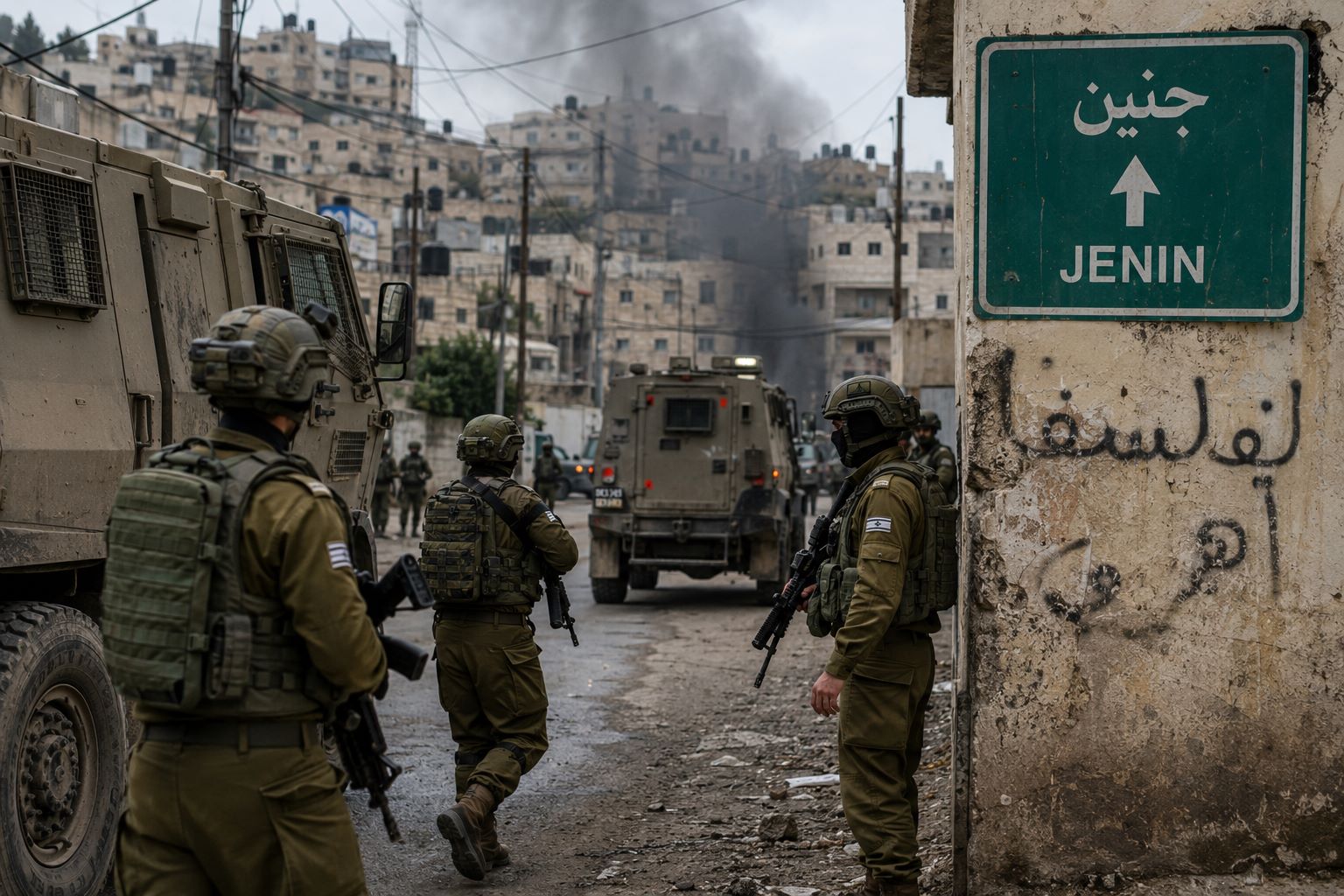
Security operations expand in northern refugee sectors as local authorities report fatal shooting near Jenin security cordon.
Publication Date: May 18, 2026
Last Updated: May 18, 2026
Byline: Global War News Editorial
The Israeli military has expanded its operational footprint across the northern West Bank, executing security raids and localized checkpoints in the hours following the fatal shooting of a Palestinian man. The security sweeps, which occurred between May 16 and May 18, 2026, have intensified friction across multiple Palestinian communities that are already subject to prolonged military restrictions.
According to statements issued by the Ramallah-based Palestinian Ministry of Health, the initial escalation occurred on Saturday when a 34-year-old civilian sustained a fatal gunshot wound near the perimeter of a heavily restricted sector. Local medical teams from the Palestinian Red Crescent Society confirmed that emergency responders transported the individual from the site without vital signs, pronouncing him dead shortly after arrival at a nearby facility.
The Israel Defense Forces did not immediately issue a specific formal comment addressing the deployment of lethal force during the weekend incident. However, military sources noted that independent units continue to enforce strict perimeter protocols around major refugee centers, operating under a long-term strategy designed to neutralize localized networks of armed groups.
The Initial Shooting Incident and Territorial Restrictions
The underlying incident that prompted the subsequent military sweeps occurred on the outskirts of the Jenin refugee camp, a densely populated municipal enclave in the northern West Bank. The Palestinian Ministry of Health identified the deceased individual as Nour al-Din Kamal Hassan Fayyad, a resident of Wadi Burqin, a village situated just west of Jenin city.
Witnesses and local administrative sources reported to the official Palestinian news agency Wafa that Fayyad had attempted to pass through an access point leading into the camp before security personnel opened fire. The Palestinian Red Crescent Society stated that its field teams treated a severe live bullet wound to the thigh, which quickly led to cardiac and respiratory arrest due to blood loss.
The sector where the fatal encounter took place has been completely sealed off from the broader municipality by the Israeli military for several months. Under current security regulations, displaced families are only granted sporadic, heavily vetted windows of access to inspect their homes and retrieve personal properties, a policy that local human rights advocates state has fueled ongoing civil frustration.
Progression of the Military Sweeps and Institutional Changes
Following the fatal encounter, Israeli army units supported by border police expanded their operational patrols across several adjacent districts. Local security sources told the WAFA news agency that military convoys entered the villages of al-Maniya and al-Rashayda, located east of Bethlehem, deploying personnel in central municipal squares, though no immediate mass arrests were recorded in those specific southern sectors.
Further north, witnesses reported that multi-vehicle military teams conducted search operations in the town of Dura near Hebron and inside the Jalazone refugee camp. The continuous deployment comes as Israel’s defense leadership institutes sweeping structural adjustments to its legal framework governing the occupied territories.
In a joint announcement broadcast via state channels, Israeli Defense Minister Israel Katz and National Security Minister Itamar Ben-Gvir confirmed the initiation of new legal procedures enabling military tribunals to apply expanded statutory penalties within the West Bank. The modification, executed through an amendment to the army’s “Security Instructions Order” signed by Central Command chief Avi Bluth, officially transfers Knesset-approved counter-terrorism frameworks directly into the military court system operating across the territory.
Context and Background: Operation “Iron Wall” and Spatial Control
The heightened operational activity across the West Bank is connected to a large-scale, long-term military campaign launched by the Israeli army in mid-January. The offensive, codenamed “Iron Wall,” has focused primarily on dismantling armed factions inside the northern refugee centers, including the Jenin and Tulkarem camps.
According to a status update published by the United Nations Relief and Works Agency for Palestine Refugees, the persistent combat and subsequent engineering demolitions associated with Operation Iron Wall have displaced approximately 40,000 residents from their urban properties. These camps were originally established following the 1948 Arab-Israeli conflict to house populations displaced during the formation of the state of Israel.
Data compiled by the United Nations Office for the Coordination of Humanitarian Affairs indicates that since the broader regional escalation began in October 2023, the West Bank has experienced a severe increase in both military search-and-seizure operations and violent encounters involving radical civilian factions. Sourcing from the Palestinian Liberation Organization’s monitoring commissions suggests that state forces and affiliated groups executed over 1,600 individual regulatory and enforcement actions during April alone, altering the daily mobility of the region’s 3.3 million Palestinian residents.
Analysis: Legal Integration and Security Implications
Observers note that the latest military maneuvers and the concurrent implementation of the death penalty amendment via military decree mark a significant transition in how the territory is administered. By circumventing civil legislation and modifying army orders directly, the Israeli defense cabinet is creating a separate, streamlined legal tracking mechanism for individuals accused of security offenses within the occupied zone.
For the Israeli military command, the intensive blockade of the Jenin sector represents a defensive necessity designed to isolate armed cells from their domestic support infrastructure. However, analysts suggest that the rigid application of spatial blockades risks compounding the very instability the operations seek to curtail. When individuals are cut off from basic domestic mobility, accidental encounters at security cordons are highly likely to turn lethal.
Furthermore, the domestic friction inside the West Bank remains deeply intertwined with broader regional developments. As long as diplomatic tracks regarding external border frameworks remain stalled, the Israeli security apparatus will likely maintain its policy of intensive domestic containment, ensuring that the West Bank remains a highly volatile flashpoint.
What to Watch
The critical indicator for further escalation will be the reaction of localized armed factions within Jenin and Nablus to the death of Fayyad. If militant cells launch coordinated retaliatory IED or shooting operations against Israeli checkpoints, the army will likely expand Operation Iron Wall into adjacent villages.
On the policy front, international legal watchdogs will be monitoring the first cases brought before the restructured military courts to see how the newly authorized death penalty instructions are applied in practice.
Source Disclosure Note: This report relies on official public briefings published by the Ramallah-based Palestinian Ministry of Health, situation tracking from the Palestinian Red Crescent Society, and reporting by the official news agency Wafa. Israeli state positions are drawn from joint statements issued by Defense Minister Israel Katz and National Security Minister Itamar Ben-Gvir. Contextual data and demographic statistics are sourced from published updates by the United Nations Relief and Works Agency and independent wire reporting via Agence France-Presse and Xinhua.
This article is based on publicly available reporting from named international news agencies and attributed official statements. All claims about ongoing events are attributed to their original sources. Analysis sections represent the editorial interpretation of reported facts and do not constitute advocacy for any party to the described conflict. AI tools may be utilized for image generation to assist in explaining complex concepts, as well as for refining grammar, spelling, and other linguistic enhancements. However, all original content is produced, fact-checked, and revised by the editorial team. This publication does not take political positions on active military conflicts.