
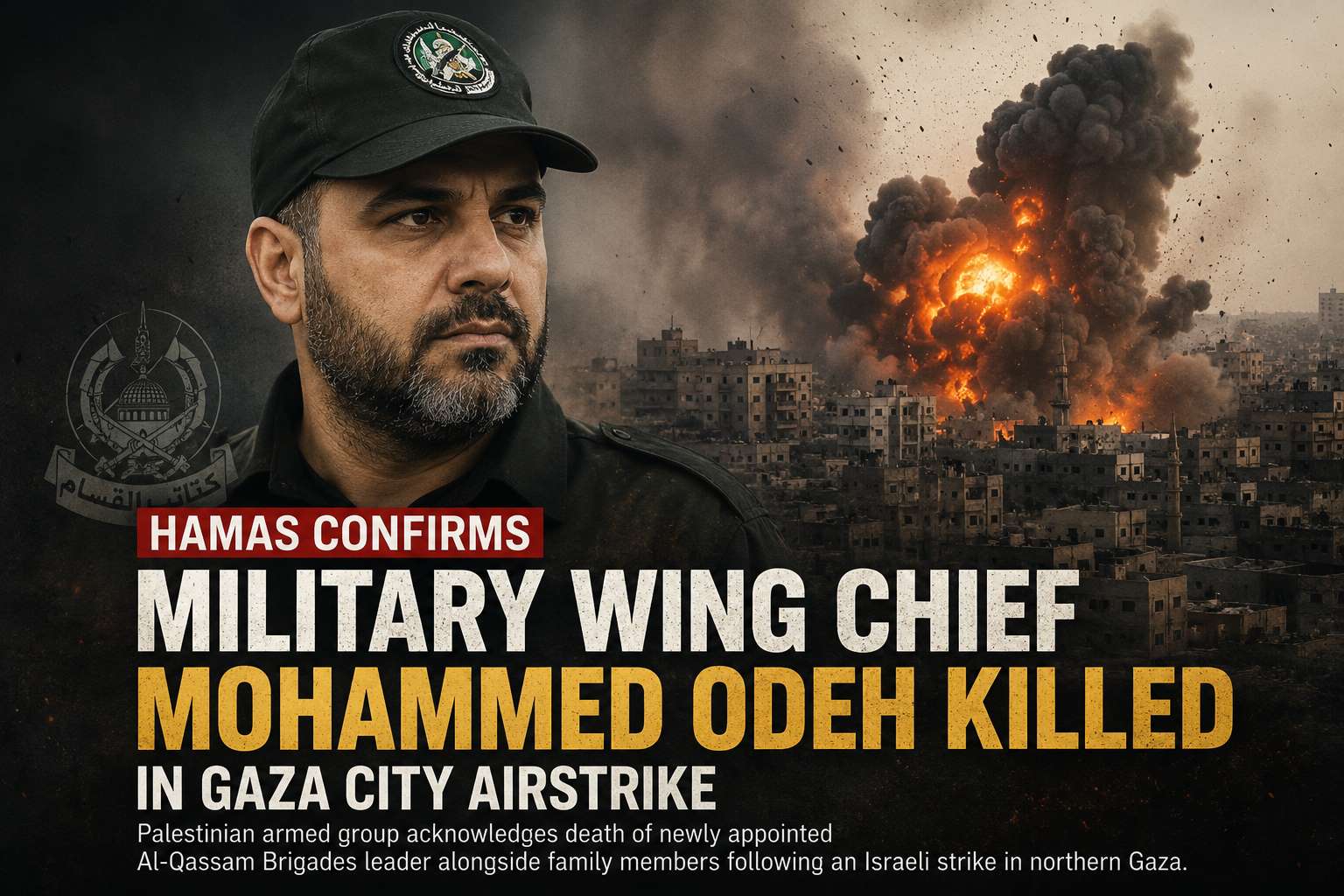
Palestinian armed group acknowledges death of newly appointed Al-Qassam Brigades leader alongside family members following an Israeli strike in northern Gaza.
Publication Date: May 28, 2026
Last Updated: May 29, 2026
Byline: Global War News Editorial
Hamas has officially confirmed that Mohammed Odeh, the newly appointed commander-in-chief of its military wing, the Ezzedine Al-Qassam Brigades, was killed in an Israeli airstrike in Gaza City on Tuesday evening.
The announcement from the Palestinian group came shortly after Israeli authorities publicly stated they had targeted and eliminated Odeh. According to statements from local medical officials in Gaza, the strike occurred in a residential area near a market in Gaza City, killing at least five people and injuring 12 others. Hamas reported that Odeh’s wife and two of his children were among those killed in the attack.
Odeh had assumed leadership of the Al-Qassam Brigades less than two weeks prior to the strike, following the death of his predecessor, Izz al-Din al-Haddad, who was killed in a similar Israeli operation on May 15.
Details of the Strike and Funeral
The strike took place on Tuesday evening, on the eve of the Muslim holiday of Eid al-Adha. Footage obtained by international news agencies showed flames emerging from the upper floors of a damaged building, with local emergency teams and bystanders transferring casualties to nearby medical facilities, including Shifa Hospital.
On Wednesday, thousands of mourners gathered in Gaza City for the joint funeral of Odeh and his family members, as reported by journalists from Agence France-Presse (AFP). The bodies, draped in green Hamas flags, were carried through the streets from a local mosque.
Israeli Defense Minister Israel Katz issued a joint statement with Prime Minister Benjamin Netanyahu confirming the operation, describing Odeh as a key military figure who previously served as Hamas’s head of intelligence during the October 7, 2023, attacks on southern Israel. Katz stated that Israel remains committed to preventing Hamas from maintaining military or civilian control over the Gaza Strip.
Context and Background
Mohammed Odeh was born in Gaza’s Jabaliya refugee camp in 1974 and had been active within Hamas for more than three decades, according to a biography released by the group. He was considered part of the early generation that established the movement’s armed infrastructure, serving extensively in its internal security apparatus, Majd, before transitioning to its intelligence services.
Odeh is the fourth commander to head the Al-Qassam Brigades since the escalation of the conflict in October 2023. Israel has systematically targeted the group’s senior leadership over the last two years. Notable figures killed include longtime commander Mohammed Deif, subsequent leader Mohammed Sinwar, and Izz al-Din al-Haddad.
A ceasefire framework signed last October called for a cessation of major hostilities, an Israeli military withdrawal, and the eventual disarmament of Palestinian factions. However, the agreement has remained fragile and has not been fully implemented. Local health authorities in Gaza state that subsequent military actions have led to further casualties, while the Israeli military maintains that it continues to conduct targeted operations against active threats and violations of the truce.
Analysis: The Attrition of Hamas Leadership
The rapid succession of strikes against top Al-Qassam commanders highlights the intense intelligence capabilities being deployed in the enclave. Analysts note that the killing of a military chief just 11 days after his appointment demonstrates a significant gap in the group’s operational security and highlights the difficulty Hamas faces in stabilizing its command structure under persistent surveillance.
With the core of the historic Al-Qassam leadership heavily degraded, regional security experts suggest that command may devolve further to remaining senior figures such as senior commander Fayez Baroud or intelligence chief Imad Aqel. Observers note that while these targeted operations disrupt immediate tactical planning, the highly decentralized nature of underground armed cells makes it unclear whether the loss of high-level commanders will completely halt local insurgent operations or instead push remaining factions toward independent actions.
Source Disclosure Note: This report relies on official press statements issued by Hamas, joint official statements from Israeli Defense Minister Israel Katz and Prime Minister Benjamin Netanyahu, and field reporting from international news agencies including Agence France-Presse (AFP), the Associated Press (AP), and Xinhua News Agency. Casualty and medical details were sourced via statements from Shifa Hospital and local Palestinian medical officials.
This article is based on publicly available reporting from named international news agencies and attributed official statements. All claims about ongoing events are attributed to their original sources. Analysis sections represent the editorial interpretation of reported facts and do not constitute advocacy for any party to the described conflict. AI tools may be utilized for image generation to assist in explaining complex concepts, as well as for refining grammar, spelling, and other linguistic enhancements. However, all original content is produced, fact-checked, and revised by the editorial team. This publication does not take political positions on active military conflicts.