
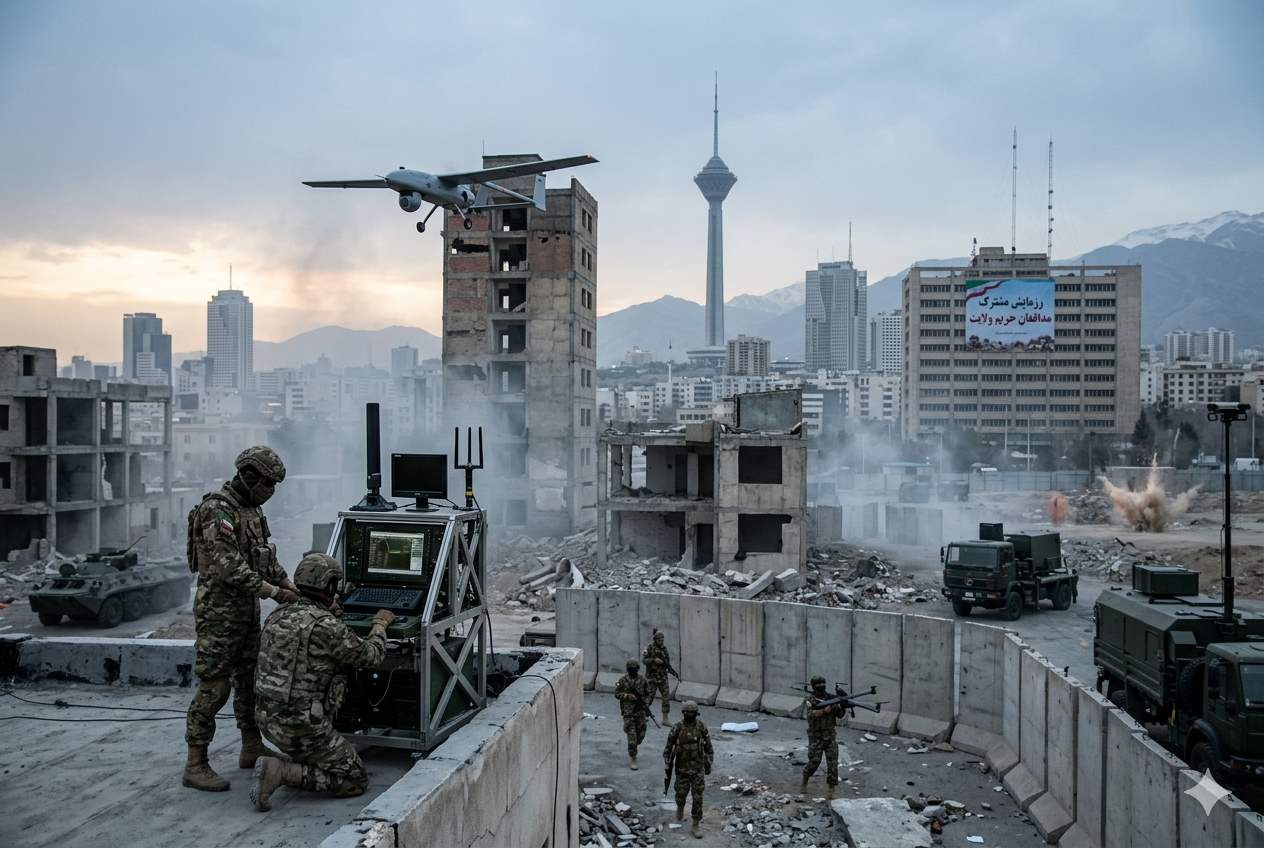
Exercises focus on urban defense and drone coordination as regional diplomatic efforts remain stalled
May 13, 2026
Last updated: 23:15 GMT
By Global War News Editorial
The Islamic Revolutionary Guard Corps (IRGC) began a series of large-scale military exercises in and around Tehran on Wednesday, according to reports from Iranian state media. The drills, which involve various divisions of the IRGC’s ground and aerospace forces, are reportedly focused on urban defense tactics and the integration of surveillance and attack drones into metropolitan security frameworks.
According to a statement carried by the Islamic Republic News Agency (IRNA), the exercises are intended to “test the readiness of the Guard to respond to asymmetric threats” and secure critical infrastructure. The timing of the drills has drawn attention from international observers, as they coincide with a period of significant uncertainty regarding the sustainability of current regional ceasefire agreements and stalled diplomatic negotiations.
While Tehran has characterized the maneuvers as routine and defensive in nature, the scale of the mobilization has raised questions among regional neighbors about the current military posture of the Islamic Republic.
Scope of the Military Exercises
The maneuvers, titled “Persistent Security 2026,” reportedly involve thousands of personnel and a significant array of domestically produced military hardware. According to reporting by Al Jazeera, the drills include the deployment of the “Shahed” series of loitering munitions and the testing of new electronic warfare systems designed to disrupt satellite communications.
Local footage broadcast on state-run television showed IRGC units practicing the cordoning of “simulated sensitive zones” and conducting rapid-response drills involving helicopter-borne infantry. Iranian officials stated that the exercises are not directed at any specific country but are necessary to maintain deterrence in a “volatile regional environment.”
The IDF and US Central Command (CENTCOM) have both indicated they are monitoring the activity. In a brief statement, a CENTCOM spokesperson noted that while military drills are common, “the concentration of advanced drone assets in a metropolitan area is a development we are watching closely.”
Diplomatic and Economic Context
The drills are taking place against a backdrop of fragile regional diplomacy. Negotiations intended to formalize a permanent de-escalation framework between Iran and its regional rivals have reportedly slowed in recent weeks. According to Reuters, citing anonymous diplomatic sources, the primary sticking points remain the monitoring of ballistic missile stockpiles and the status of regional maritime corridors.
Observers note that Iran often utilizes high-profile military displays during periods of diplomatic stalemate to demonstrate domestic strength and leverage. However, these displays frequently carry an economic cost. Following the announcement of the Tehran drills, the Iranian Rial saw a 0.8% dip against the US Dollar on the unregulated market, reflecting investor sensitivity to potential escalations.
Furthermore, the regional energy market remains reactive to Iranian military posturing. Analysts at the International Energy Agency (IEA) have previously noted that military activity near Tehran, while not directly on the coast, often signals a broader readiness that can affect insurance premiums for shipping in the nearby Persian Gulf.
Analysis: What This Could Mean
The focus on urban defense and drone coordination suggests a shift in the IRGC’s tactical priorities. Analysts have suggested that the lessons learned from recent global conflicts, particularly the high utility of drones in urban environments, are being integrated into Iran’s own defensive doctrines.
“The IRGC is clearly signaling its ability to maintain internal order and secure the capital against a variety of modern threats,” noted a security analyst based in Istanbul. “This is as much a message to domestic audiences as it is to international rivals.”
It remains unclear whether the “Persistent Security” drills will be followed by similar exercises in the Strait of Hormuz or other coastal regions. Should the maneuvers expand to maritime zones, the impact on global shipping and oil prices would likely be more pronounced. For now, the focus remains on Tehran, where the heavy presence of military hardware serves as a visible reminder of the current state of regional tension.
Source Disclosure Note: This report is based on official statements from the Islamic Republic News Agency (IRNA), reporting from Al Jazeera and Reuters, and military activity monitoring provided by independent regional analysts. Supplemental economic data was sourced from unregulated market trackers and IEA briefings.
This article is based on publicly available reporting from named international news agencies and attributed official statements. All claims about ongoing events are attributed to their original sources. Analysis sections represent the editorial interpretation of reported facts and do not constitute advocacy for any party to the described conflict. AI tools may be utilized for image generation to assist in explaining complex concepts, as well as for refining grammar, spelling, and other linguistic enhancements. However, all original content is produced, fact-checked, and revised by the editorial team. This publication does not take political positions on active military conflicts.