
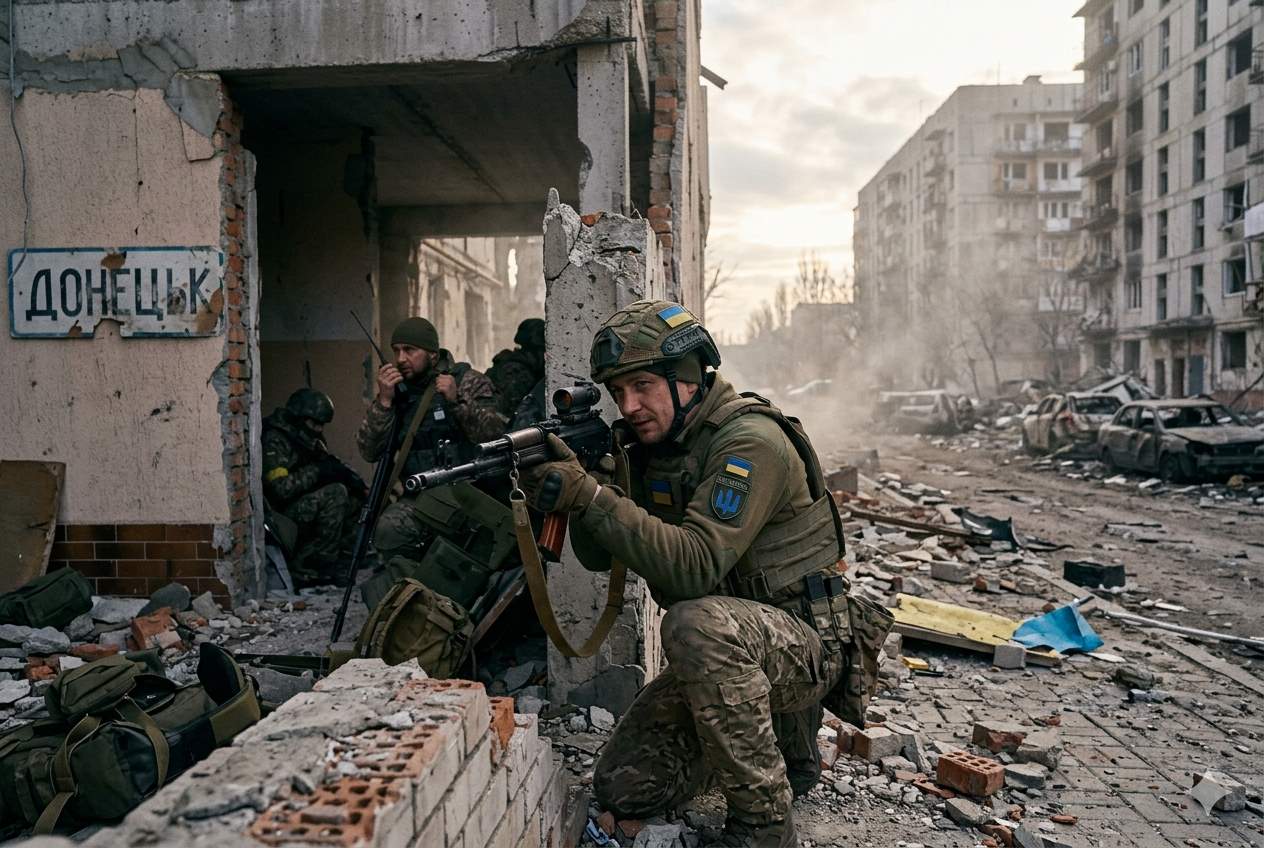
Military observers report tactical adjustments near key logistics hubs as frontline pressure mounts.
April 16, 2026
Last Updated: 09:30 AM
By Staff Writer, Global War News
The landscape of the conflict in Eastern Ukraine has undergone a visible shift over the last 72 hours. According to reports from regional military observers and data analyzed by international news agencies, frontline positions near the city of Donetsk have seen a series of tactical movements. These developments mark a period of intensified urban engagement as both forces adjust to changing geographical realities on the ground.
Recent updates indicate that the focus of activity has centered on the outskirts of several strategic settlements. Observers note that the shifting frontlines are a result of sustained pressure and a series of localized maneuvers intended to secure high-ground positions. While the broader strategic picture remains fluid, the immediate impact is a heightened state of alert for civilian populations remaining in the vicinity of the Donetsk administrative boundary.
According to a statement from the UK Ministry of Defence, recent satellite imagery and field reports suggest a marginal but significant redistribution of forces. The report stated that these movements likely aim to consolidate control over vital supply routes that link the primary urban centers of the Donbas region. Meanwhile, local military blogs, though not independently verified, have suggested that the intensity of drone surveillance in these sectors has reached its highest level since the start of the spring season.
Tactical Movements and Territorial Changes
As reported by Reuters, the current phase of the engagement is characterized by heavy shelling and close-quarters combat in semi-urban environments. The nature of these engagements makes the verification of territorial gains or losses particularly difficult. However, the Associated Press has noted that several previously contested “gray zones”—areas between the two opposing frontlines—have now been absorbed into active combat sectors.
In a public briefing, a spokesperson for the regional administration stated that the change in frontline geometry has forced the evacuation of approximately 200 additional civilians from the frontline villages. The spokesperson added that the logistical challenge of these evacuations is compounded by the reported damage to secondary roads, which are essential for civilian transport but have become targets for tactical strikes.
Logistics and Supply Line Pressure
The strategic significance of the Donetsk front lies in its proximity to essential rail and road junctions. According to analysis provided by the Institute for the Study of War (ISW), any significant movement in these lines directly affects the ability of both parties to sustain prolonged operations. The ISW reported that the current shift appears to be a concerted effort to disrupt the “logistics tail” of defending units, potentially forcing a withdrawal from exposed salients.
Reports from Agence France-Presse (AFP) indicate that there has been an uptick in the use of precision-guided munitions targeting storage facilities. While the exact success rate of these strikes remains a matter of dispute between official military communiqués, the visual evidence of smoke plumes over industrial zones suggests that high-value infrastructure is being prioritized in the current offensive.
Analysis: What This Shift Could Mean
Observers note that the movement of frontlines in this sector often precedes larger-scale seasonal operations. This tactical “shuffling” suggests that both sides are attempting to improve their defensive posture before the ground dries completely, allowing for more rapid mechanized movement.
The current engagements also raise questions about the long-term sustainability of urban defense in smaller satellite towns. If the frontlines continue to push toward major logistical arteries, the risk of encirclement for localized units becomes a primary concern for military planners. Analysts suggest that we are seeing a transition from a war of attrition toward a more dynamic, albeit slow-moving, war of position.
Current Status and Outlook
As of this morning, the situation remains highly volatile. Official statements from both capitals offer conflicting accounts of which side holds the momentum. While one side claims the successful “straightening” of the line to improve defensive efficiency, the other reports “significant breakthroughs” in key tactical sectors.
The full picture remains unclear, as independent journalists on the ground face severe movement restrictions. For now, the focus remains on the humanitarian corridors and the ability of aid organizations to reach those caught in the shifting crossfire.
Sources: This report utilizes data and statements from the UK Ministry of Defence, Reuters, The Associated Press, Agence France-Presse (AFP), the Institute for the Study of War (ISW), and official regional administrative briefings.
This article is based on publicly available reporting from named international news agencies and attributed official statements. All claims about ongoing events are attributed to their original sources. Analysis sections represent the editorial interpretation of reported facts and do not constitute advocacy for any party to the described conflict. AI tools may be utilized for image generation to assist in explaining complex concepts, as well as for refining grammar, spelling, and other linguistic enhancements. However, all original content is produced, fact-checked, and revised by the editorial team. This publication does not take political positions on active military conflicts.