
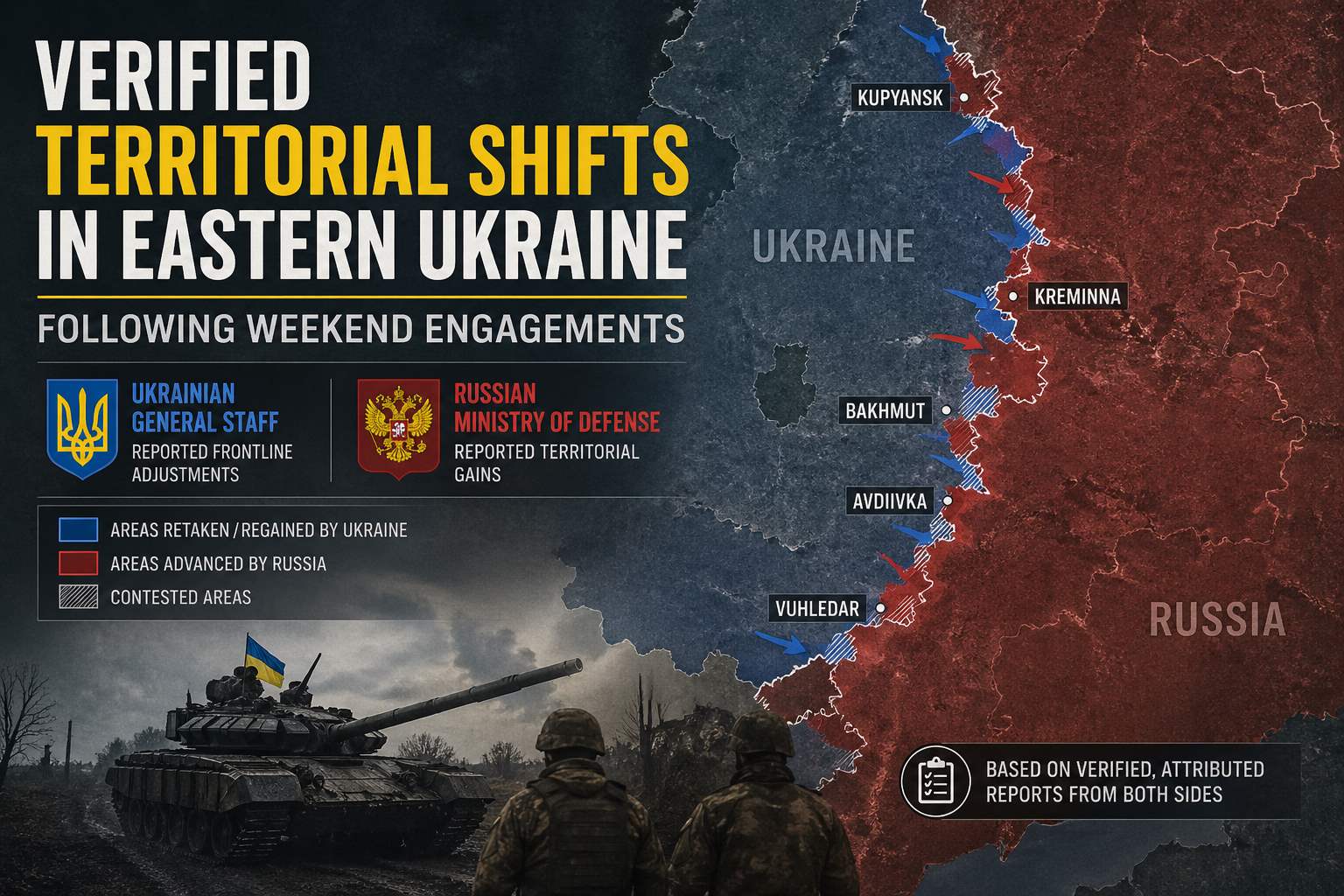
Military sources from both sides report localized adjustments along the Donetsk and Luhansk frontlines as spring conditions impact maneuvers.
April 28, 2026
Last Updated: April 28, 2026
By Global War News Editorial
Recent military engagements over the weekend have resulted in confirmed shifts in territorial control across the eastern theater of Ukraine. Official reports from the Ukrainian General Staff and the Russian Ministry of Defense indicate that while the broad frontline remains largely consistent, specific villages and tactical heights have changed hands following intense localized fighting.
The adjustments are concentrated primarily in the sectors surrounding the ruins of Bakhmut and the outskirts of Lyman. Military analysts suggest these movements represent tactical positioning rather than a large-scale strategic breakthrough. The shifts occur as seasonal weather changes begin to influence the mobility of heavy armor and logistics chains in the Donbas region.
According to ground reports, the weekend saw an increase in artillery exchanges and small-unit operations. Both warring parties have issued statements claiming progress, though international monitors continue to emphasize that the humanitarian situation for remaining civilians in these sectors remains critical.
Frontline Adjustments in the Donetsk Sector
According to a statement released by the Ukrainian General Staff on Sunday, Ukrainian forces have successfully re-established positions in a wooded area approximately three kilometers east of Chasiv Yar. The statement noted that these positions were regained following a series of coordinated counter-attacks.
Conversely, the Russian Ministry of Defense claimed in its daily briefing on Monday that its units had secured a more favorable tactical position near the settlement of Ivanivske. Russian official sources stated that their forces had repelled several Ukrainian assaults in the area, resulting in a slight westward shift of the contact line.
Independent observers from the Institute for the Study of War (ISW) noted that geolocation data from the weekend confirms minor Russian advances in the southern industrial zone of the region, while Ukrainian forces appear to have strengthened their defensive perimeter in the northern hills. These conflicting reports illustrate the fluid nature of the current combat environment.
Escalation Near the Luhansk Border
Further north, near the border between Donetsk and Luhansk, the intensity of combat has shifted toward the Lyman direction. The Associated Press reported that local officials in the region described “non-stop” shelling throughout Saturday night.
A spokesperson for the Ukrainian Eastern Group of Forces stated that Russian units had attempted to cross a local tributary of the Siverskyi Donets River. According to the spokesperson, the attempt was intercepted, though the resulting “gray zone”—territory not fully controlled by either side—has reportedly expanded by several hundred meters.
The Russian state news agency TASS reported that Russian tactical groups had “leveled the frontline” near the village of Terny. While the agency claimed the capture of several Ukrainian strongpoints, these claims have not been independently verified by international news agencies or neutral observers on the ground.
Analysis: The Tactical Significance of Current Shifts
Analysts suggest these weekend maneuvers are part of a broader “war of attrition” where small gains are prioritized over rapid territorial capture. The current shifts, while significant for the units involved, do not yet indicate a collapse of defensive lines on either side.
Observers note that the focus on high-ground positions around Chasiv Yar suggests that both commands are preparing for more substantial operations as the terrain dries. The proximity of these engagements to vital supply roads means that even a shift of five hundred meters can bring logistical hubs within range of short-range mortar fire, complicating the delivery of food, fuel, and ammunition.
It remains unclear whether either side possesses the immediate reserves necessary to exploit these localized gains into a wider breach. For now, the conflict remains characterized by high-intensity combat over limited geographic areas.
Closing Summary
As of late Monday, the frontline has stabilized in the sectors affected by the weekend’s engagements. International news agencies continue to monitor for signs of further escalation, particularly in the direction of the Oskil River. We will continue to track these developments as official data from both the UN and defense ministries becomes available.
Sources: This report utilizes official statements from the Ukrainian General Staff and the Russian Ministry of Defense. Secondary reporting was provided by Reuters, the Associated Press, and TASS. Tactical analysis incorporates assessments from the Institute for the Study of War (ISW).
This article is based on publicly available reporting from named international news agencies and attributed official statements. All claims about ongoing events are attributed to their original sources. Analysis sections represent the editorial interpretation of reported facts and do not constitute advocacy for any party to the described conflict. AI tools may be utilized for image generation to assist in explaining complex concepts, as well as for refining grammar, spelling, and other linguistic enhancements. However, all original content is produced, fact-checked, and revised by the editorial team. This publication does not take political positions on active military conflicts.